Friday, July 9, 2010

May 2010 Industrial Production: A Pleasant Surprise

So much for the expectations that GDP growth will slow in the second quarter. Export growth numbers weren’t very encouraging, but it appears domestic production has more than offset slowing external demand (log annual and monthly changes; seasonally adjusted; 2000=100):

01_ipi_gr02_ipi_grc

Both mining and electricity production were flat in May relative to April, but manufacturing output has ticked up (for now). But growth is certainly not coming from the export-oriented subsectors like electronics (log annual and monthly changes; seasonally adjusted; 2000=100):

03_eeI’m still working on the detailed numbers but it certainly seems as if we’re seeing a structural shift towards domestic-oriented manufacturing – and not before time, considering the external outlook.

I’ve also checked the relationship between IPI and exports (single-equation, VAR etc) and while it’s possible to forecast exports and IPI through lags of each variable, it’s an iffy proposition – lots of statistical problems like serial correlation and heteroscedasticity. A cointegration test reveals no long term relationship between the two variables, and Granger causality tests turned up negative. In short, exports are not a good guide for values of IPI nor vice versa, and any regression based on these two variables will be spurious.

So, what does the IPI imply for 2Q 2010 GDP? No cointegration problem here, so there is a long term relationship, although causality tests are negative. So it’s possible to forecast GDP using IPI values, as long as you recognise that we’re not talking about an increase in IPI “causing” GDP to rise, and you don’t mind using a forecasting regression rather than a full-featured, theoretically-correct structural model. Also bear in mind that we’re only looking here at two month’s worth of IPI numbers (April-May) for the second quarter, so June IPI numbers may materially change the forecast.

With those caveats in mind, I got a point forecast of RM139.5 billion and a range forecast at the 95% level of RM142.2-136.8 billion, which imply a y-o-y annual growth rate of 9.6% (range: 11.8%-7.5%), and a q-o-q seasonally adjusted annualised growth rate of 8.9%. The former implies a slight slowdown over 1Q 2010, while the latter suggests economic growth accelerated instead:

04_forecastOne further implication is that all this talk of further fiscal stimulus may be premature. If the domestic economy is still picking up, despite expectations of an external slowdown in the second half off this year, then there’s not much call for additional public support for the economy.

Technical Notes:

May 2010 Industrial Production Report from DOS

Thursday, July 8, 2010

Oops!…They Did It Again

As expected, but not necessarily as desired (at least in my mind), BNM have raised the OPR another 25bp. Read the statement here.

But BNM are also signalling that this will be it for a while (emphasis mine):

The MPC considers the new level of the OPR to be appropriate and consistent with the current assessment of the growth and inflation prospects. The stance of monetary policy continues to remain accommodative and supportive of economic growth.

Unless something drastically changes to the economic outlook, I’d expect the OPR to stay at this level until the end of the year.

Deficits or Austerity?

If you're not quite clear on the theoretical basis for deficit spending in recessions, this is a must read (excerpt):

Fiscal austerity – the newest fallacy of composition

Prior to the 1930s, there was no separate study called macroeconomics. The mainstream theory – which dominates still today – considered macroeconomics to be an aggregation of the individual. So the representative firm and household were just made bigger but the underlying behavioural principles that were brought to bear on the analysis were those that applied at the individual level.

So the economy is seen as being just like a household or single firm. Accordingly, changes in behaviour or circumstances that might benefit the individual or the firm are automatically claimed to be of benefit to the economy as a whole.

The general reasoning failure that occurs when one tries to apply logic that might operate at a micro level to the macro level is called the fallacy of composition. In fact, it is what led to the establishment of macroeconomics as a separate discipline. As indicated, prior to the Great Depression, macroeconomics was thought of as an aggregation of microeconomics. The neo-classical economists (who are the precursors to the modern neo-liberals) didn’t understand the fallacy of composition trap and advocated spending cuts and wage cuts at the height of the Depression.

The question here is whether the same conditions apply here in Malaysia – the examples used in the post best fit a "closed" economy with no external sector. In our case, we're facing a shortfall in external demand, not domestic demand, where consumers in developed countries are trying to save more. But in that case, what we should be arguing about is not whether the government should intervene to maintain aggregate demand, but what form that intervention should take (note: one more reason why BNM should not raise the OPR today).

I’m in two minds about the rather vague reports in the papers of “major projects”, as the problem with that is the empirical support for high multiplier effects of spending on construction is in developed economies with relatively small external sectors. Given the high import content of our construction materials, I’m not sure that import leakage might not completely offset the long term gains from infrastructure investment.

There hasn’t been much research done on fiscal multipliers in developing countries, so while the general theoretical basis is there, the empirical evidence in support is not. We are in some ways flying blind here – hopefully there isn't a mountain in the way.

Wednesday, July 7, 2010

A New (Old) Way To Launder Money

This isn’t exactly on economics or even on Malaysia, but I couldn’t resist posting this:

Zimbabweans wash dirty US dollars with soap, water

By ANGUS SHAW, Associated Press Writer Angus Shaw, Associated Press Writer – Tue Jul 6, 10:19 am ET

HARARE, Zimbabwe – The washing machine cycle takes about 45 minutes — and George Washington comes out much cleaner in the Zimbabwe-style laundering of dirty money.

Low-denomination U.S bank notes change hands until they fall apart here in Africa, and the bills are routinely carried in underwear and shoes through crime-ridden slums.

Some have become almost too smelly to handle, so Zimbabweans have taken to putting their $1 bills through the spin cycle and hanging them up to dry with clothes pins alongside sheets and items of clothing.

It's the best solution — apart from rubber gloves or disinfectant wipes — in a continent where the U.S. dollar has long been the currency of choice and where the lifespan of a dollar far exceeds what the U.S. Federal Reserve intends.

Zimbabwe's coalition government officially declared the U.S. dollar legal tender last year to eradicate world record inflation of billions of percent in the local Zimbabwe dollar as the economy collapsed.

The U.S. Federal Reserve destroys about 7,000 tons of worn-out money every year. It says the average $1 bill circulates in the United States for about 20 months — nowhere near its African life span of many years.

Larger denominations coming in through banks and formal import and export trade are less soiled.

But among Africa's poor, the $1, $2, $5 and $10 bills are the most sought after. Dirty $1 bills can remain in circulation at rural markets, bus parks and beer halls almost indefinitely, or at least until they finally disintegrate.

Still, banks and most businesses in Zimbabwe do not accept torn, Scotch-taped, scorched, defaced, exceptionally dirty or otherwise damaged U.S. notes.

Zimbabweans say the U.S. notes do best with gentle hand-washing in warm water. But at a laundry and dry cleaner in eastern Harare, a machine cycle does little harm either to the cotton-weave type of paper. Locals say chemical "dry cleaning" is not recommended — it fades the color of the famed greenback.

Laundry worker Alex Mupondi said customers asked him to try machine-washing a selection of bills and the result impressed him.

But storekeeper Jackie Dube hasn't yet taken up advice of friends to cleanse the often damp and stinking U.S. dollars she receives for the garments and cheap Chinese consumer goods she sells in Harare. It's time-consuming, she says, adding that stinky, unhygienic bills are a problem.

"I get rid of the worst of the notes as soon as I can in change," she said.

APTOPIX Zimbabwe Money LaunderingAlex Mupondi, hangs one dollar notes on a drying line after washing them in Harare, Zimbabwe, Tuesday, July 6, 2010. The washing machine cycle takes about 45 minutes — and George Washington comes out much cleaner than before in Zimbabwe-style laundering of dirty money. Zimbabweans trading in the American currency since their own hyperinflationary notes were abandoned last year say washing their dirtiest cash works. (AP Photo/Tsvangirayi Mukwazhi)

Census 2010 Begins Today!

…and will go on for the next six weeks:

Population census on for next six weeks

KUALA LUMPUR: The fifth national population census has begun with enumerators making a special effort last night to seek out homeless people in several cities.

During the six-week period (July 6 to Aug 22), 29,000 enumerators will visit an estimated 7.5 million homes to collect data that is vital for the planning and implementation of government policies.

Other developments:

> CHIEF Statistician Datuk Wan Ramlah Wan Abdul Raof said under normal circumstances only one enumerator would visit a residence at a time. If there is more than one officer approaching the household, residents can call the department hotline at 1-800-88-7828 for verification; and

> RESPONDENTS can also opt to provide their particulars using the e-Census form by visiting http://www.statistics.gov.my. Chief Secretary to the Govern­ment Tan Sri Sidek Hassan, who took only 10 minutes to fill the e-Census form, calls on the public to utilise the Govern­ment’s e-services.

Remember: safety first – there should not be more than one enumerator visiting, so keep your local police station number handy.

Also if you’re working and don’t have the time to fill out the survey form, you can also participate online here.

Tuesday, July 6, 2010

Recent Imposition Of Capital Controls In East Asia

An interesting piece of research has turned up on VoxEU (excerpt):

Emerging markets consider capital controls to regulate speculative capital flows
Kavaljit Singh

Despite recovering faster than developed countries, many emerging markets are struggling to cope with large capital inflows. This column discusses the recent capital controls imposed by Indonesia and South Korea. It argues that while the international community is warming to these policies, it would be wrong to view capital controls as a panacea...

...Just days before the G20 summit in Toronto, South Korea and Indonesia announced several policy measures to regulate potentially destabilising capital flows which could pose a threat to their economies and financial systems...

...Despite recovering faster than developed countries, many emerging markets are finding it difficult to cope with large capital inflows. There is a growing concern that the loose monetary and fiscal policies currently adopted by many developed countries are promoting a large dollar “carry trade” to buy assets in emerging markets.

Apart from currency appreciation pressures, the fears of inflation and asset bubbles are very strong in many emerging markets. Since mid-2009, stock markets in emerging economies have witnessed a spectacular rally due to strong capital inflows. In particular, Brazil, Russia, India and China are the major recipient of capital inflows.

The signs of asset price bubbles are more pronounced in Asia as the region’s economic growth will continue to outperform the rest of the world. As a result, the authorities are adopting a cautious approach towards hot money flows and considering a variety of policy measures (from taxing specific sectors to capital controls) to regulate such flows. In May 2010, for instance, Hong Kong and China imposed new measures in an attempt to curb soaring real estate prices and prevent a property bubble.

In emerging markets, strong capital inflows are likely to persist due to favourable growth prospects but the real challenge is to how to control and channel such inflows into productive economy.

Contrary to the popular perception, capital controls have been extensively used by both the developed and developing countries in the past. There is a paradox between the use of capital controls in theory and in practice (Nembhard 1996). Although mainstream theory suggests that controls are distortionary and ineffective, several successful economies have used them in the past (Nembhard 1996). China and India, two major Asian economies and “success stories” of economic globalisation, still use capital controls today...

...Yet it would be incorrect to view capital controls as a panacea to all the ills plaguing the present-day global financial system. It needs to be underscored that capital controls must be an integral part of regulatory and supervisory measures to maintain financial and macroeconomic stability (Singh 2000). Any wisdom that considers capital controls as short-term and isolated measures is unlikely to succeed in the long run.

The theoretical (or should I say theological) basis for an open capital account, where capital of any sort is allowed to enter and leave freely, is that capital will flow to where it can be used most productively (i.e. where capital is relatively scarce, and would then attract higher returns). An open capital account should therefore result in lower cost of capital for the recipient, which will result in an increase in investment in productive capital which then raises incomes and social welfare. That’s the free-market, neo-classical story anyway.

The problem here is that there is an underlying assumption that the country involved is big enough that capital inflows/outflows won’t have a significant impact on monetary conditions – that’s simply not true of many developing economies in the context of a relatively more massive global financial system. (I’m leaving out here the empirical “puzzle” that capital doesn’t in fact flow to capital-scarce nations – quite the opposite actually occurs. Otherwise, Africa would be the number one destination of foreign capital and investment).

There are a number of ways a country can manage outsized capital inflows and outflows – reserve accumulation as an insurance policy, as is common in East Asia and the oil-rich Middle East; sterilisation through issuance of central bank liabilities, which can get expensive; and of course capital controls.

The general practice has been that if the domestic financial sector and capital markets don’t have the capacity, breadth or depth to absorb large-scale short-term capital, then capital controls are the instrument of choice, never mind investor opprobrium. Malaysia has had more than a few brushes with capital controls, of which 1998 was just the latest.

At the moment, capital flows aren’t an overriding concern here (we’re not as “exciting” an investment story as Indonesia, China or India), but that may change if interest rates and yields in developing countries remain ultra-low for an extended period.

Technical Notes:

Singh, Kavaljit, “Emerging markets consider capital controls to regulate speculative capital flows”, VoxEU.org, July 5 2010

2009 International Investment Position

The Department of Statistics last week issued Malaysia’s IIP report for 2009, which shows the level of Malaysian ownership of foreign assets matched against foreign ownership of Malaysian-domiciled assets. If you want a simpler business-type analogy, the balance of payments is our external cash flow report while the IIP is our external balance sheet report.

I’ve noted before that Malaysia has become a net creditor nation in 2008 – we own more foreign assets than foreigners own our assets – and for the first time since independence. The 2009 data more than confirms this trend (RM millions):

01_iipWe’re now RM120 billion to the good, compared with around negative RM140 billion in the early part of this decade, and worlds away from the more than RM700 billion in the red in 1986 (source: see note 2).

Now whether this is good or bad depends on your point of view. The rapid increase in foreign asset accumulation in the last 5-6 years has largely been driven by direct investment (and reinvestment of earnings) abroad by Malaysian companies (RM millions):

02_assets

…compared with relative stability in foreign accumulation of Malaysian assets (RM millions):

03_liab…apart from portfolio capital which remains highly volatile (RM millions):

 04_port

The problem here is that Malaysian companies are investing abroad corporate savings that might have been invested domestically – one reason why private investment growth has been so poor since the 1997-98 crisis, and why we have not been able to match the growth rates in GDP that we saw pre-1997. The outflow of funds (we’re talking about half a trillion Ringgit over the last ten years) has also played a role in dampening appreciation of the Ringgit.

The flip side of this is of course, that our income account in the balance of payments is going to improve over time as investments (hopefully) bear fruit – a source of foreign exchange which will be non-trade related, and thus reduce our external vulnerability.

One further side effect of this is that it reduces the incentive for massive accumulation of foreign exchange as an insurance policy against capital outflows, which can be expensive. Luckily, BNM has more or less ceased forex intervention (with some notable exceptions) since the float of the Ringgit in 2005, but there are still structural factors which will inhibit reducing our reserves over the short run – liquidity of foreign portfolio assets for starters, as well as the relatively higher proportion of foreign ownership of Malaysian equities and debt.

But this development does mean that one of the underpinnings of the Ringgit’s valuation is long term positive.

Technical Notes:

  1. 2009 International Investment Position from the Department of Statistics
  2. Lane, Philip R. & Milesi-Ferretti, Gian Maria, “The External Wealth of Nations Mark II: Revised and Extended Estimates of Foreign Assets and Liabilities, 1970-2004”, International Monetary Fund Working Paper 06/69, March 2006

Countdown to MPC Meeting

The consensus is leaning towards another 25bp OPR hike (excerpt):

Economists expect rate hike next week

PETALING JAYA: Although Malaysia’s year-on-year (yoy) export growth of 21.9% to RM52.3bil in May fell below market expectations, economists are still positive on an interest rate increase next week…

…Bank Negara raised its key rate by 25 basis points to 2.5% in May – a normalisation process after rate cuts during the global downturn.

AmResearch senior economist Manokaran Mottain told StarBizWeek that although the numbers showed slower-than-expected-growth, it was still at respectable rate…

…Thus, Manokaran said the interest rate hike next week would likely to go on.

“But after July 8, I think there will be a pause pending on the development then,” he said.

Standard Chartered Bank economist Alvin Liew was quoted by Reuters as saying despite the slower exports growth in April and May trade data, these two months of data still pointed to a decent second-quarter economic performance…

…“As our expectations for a healthy recovery in first half of this year remains intact, we reiterate our view that the central bank is likely to continue normalising interest rates further to suit current economic conditions.

“We expect Bank Negara to hike rates by another 25 basis points at its July 8 policy meeting and thereafter keep the overnight policy rate on hold at 2.75% for the rest of the year, which is the normal rate for the OPR in 2010, in our view,” he said.

Like any good economist, I’m in two minds (or two hands) on whether continued “normalisation” of interest rates is called for. With growth likely to slow and external demand likely to fall off, we’re still faced with a substantial output gap, i.e. there’s still unutilised capacity in the economy, which means there won’t be much pressure on consumer prices in the near term. The relative strength of the MYR also means less inflationary pressure from imported inflation.

So what’s the case for continuing to raise interest rates? BNM’s concerns will be centred, to their credit, on asset markets, which has not been a particular focus of central banks until this past financial crisis. But before getting into that, what other indicators would matter?

First, inflation is pretty tame, so raising interest rates effectively mean also a rise in real interest rates:

04_r_ir

…which is what BNM is aiming for. By raising the cost of borrowing, BNM is hoping to limit a build up of leverage and consumption that would raise consumer and asset-price inflation. Consumption indicators are up this year, such as loans (log monthly changes):

02_loans

…but not to any great extent. Housing loans are a fairly big chunk of the increase (defying the increases in interest rates: more on this later), but other loans for asset purchases aren’t too troubling (log monthly changes):03_loans_assets

…and working capital loans are growing at least as fast.

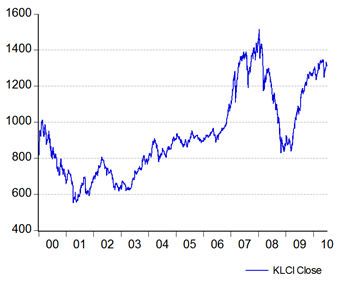
Turning to the asset markets, the FBM-KLCI has almost fully recovered to its 2007-2008 peaks, and you could argue that at these levels, the stock market is overvalued:
05_klci …which is supported by the market’s historical PE-ratio:
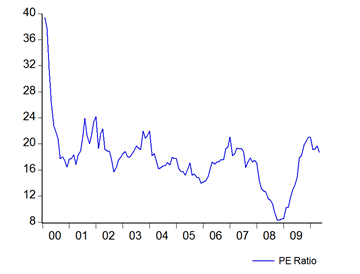
06_pe Price has outrun earnings, and the market needs a period of consolidation (i.e. companies need to start registering profits, not prospective profits). But I’d note that the stock market was well into its current sideways trading phase before BNM started raising rates, so this isn’t an obvious immediate concern.

More solidly, house prices have started to pick up at the end of 2009 (log annual changes; 2000:100):

07_mhpi

…but 3% per annum doesn’t exactly qualify us as an overheating property market. The only thing that stands out is prices of high-rises, which rose 8% in 4Q 2009, and apparently primarily in Penang. So what we’re looking at here is a potential limited market bubble confined to a small (but volatile) segment of property. Tightening monetary policy to keep a lid on this strikes me as using a hammer to swat a fly. The other aspect of this is that based on the limited data available to me, interest rates have a very limited impact on property sales – population and income growth matter much, much more.

In short, there doesn’t seem to be much of anything going on right now to justify a rapid increase in interest rates. What BNM is really doing is trying to peer through a half-obscured crystal ball and trying to head off potential asset price bubbles, but with the trade-off of slowing growth in the interest rate-sensitive parts of the economy despite an economic recovery that still isn’t fully settled.

I’ll leave this post with one further nugget – money velocity (read this post for fuller details) still hasn’t recovered to pre-crisis levels:

08_velocity

In fact, the rate of change in the velocity of monetary aggregates is still negative (log annual changes):

09_v_gr

Juxtaposing this with money supply and economic growth suggests that far from being expansionary, monetary policy is in reality still too tight:

10_m3M3 adjusted for inflation and velocity is signalling a real interest rate level of nearly 10%, far above the approximately 1% difference between the OPR and CPI/Core inflation measures. So I don’t think an interest rate hike is fully justified right now.

On the other hand (you knew that was coming, right?) here’s an alternative viewpoint, from a highly respected economist who was one of the very few to foresee the financial crisis in the US:

Monetary Policy or Fiscal Policy

...Perhaps more worrisome is the view that the main problem is aggregate demand is too low. In response to ultra-low interest rates, the thinking goes, households will cut back on savings while firms will invest more, demand will revive, and the workers who have been laid off will be rehired.

But this recession is not a “usual” recession. It followed a period of ultra-low interest rates when interest sensitive segments of the economy got a tremendous boost. The United States had far too much productive capacity devoted to durable goods and houses, because consumers could obtain financing for them easily. With households recovering slowly from the overhang of debt resulting from the binge, and with lenders extremely risk averse, it is unrealistic to expect households to spend beyond their means again, and unwise to try to tempt them to do so...

...Put differently, the productive capacity of the economy has shrunk. Resources have to be reallocated into new sectors so that any recovery is robust, and not simply a resumption of the old unsustainable binge. The United States economy has to find new pathways for growth. And this will not necessarily be facilitated by ultra-low interest rates.

What many people forget is that interest rates are also a price, and shape not only the level of economic activity but also the allocation of resources and the relative wealth of buyers and sellers of financial savings. A sustained period of ultra-low interest rates will favor the segments of the economy that took us into the crisis – housing, durable goods like cars, and finance. And it will encourage households to borrow and spend rather than save. With policies focused on reviving the patterns of behavior that proved so costly the last time around, it is ironic that President Obama wants the rest of the world to change and spend more to displace the United States as spender of first resort, even while the United States is unwilling to make any changes itself.

Put differently, aggregate demand is indeed insufficient to restore the economy to old patterns of production. But that production was absorbed only through an unsustainable debt-fueled, asset-price-boom-supported consumer binge. And even if we think U.S. consumers have become excessively cautious (it is hard to see a savings rate of 5 percent as excessive caution, except in relation to the extravagant past), moving them back down the same path seems unwise.

More important, the United States also has a problem of distorted supply. Prices in the economy should reflect the past misallocation of resources and move resources away from areas like housing and finance. A lot of people have to be retrained for the jobs that will be created in the future, not left lamenting for the jobs they had in the past. A Fed that keeps real interest rates at a sustained negative level will stand in the way of the needed reallocation.

None of this is to say that the Fed should jack up interest rates quickly without adequate warning, or to extremely high levels. There are trade-offs here, between short-term growth and long-term misallocation of resources, between reducing risk aversion and inducing excessive risk taking, between reviving hard-hit sectors and encouraging repeated bad behavior. On balance though, if and when the jitters about Europe recede, it would be prudent for the Federal Reserve to start paving the way towards positive real interest rates.

Interesting, no?

Saturday, July 3, 2010

May 2010 External Trade

In my last trade post, I said that I thought that trade would continue to contract based on my forecasting models, but inventory adjustments would cause exports to marginally increase – why, oh why, don’t I believe my own models (log annual and monthly changes; seasonally adjusted):

01_trade Exports contracted by 5.9% while imports improved 1.4% (m-o-m, seasonally adjusted, log terms), although the annual growth rates still look good for both. The main culprit was a continued contraction in electronics exports (log monthly changes; seasonally adjusted):

02_compBased on the tentative improvement in imports, I’d expect a slight rebound next month, though with China’s growth visibly slowing, there’s not much prospect for further trade growth over the next few months.

Based on the uptick in imports, there should be a rebound in June exports (fingers crossed):

Seasonally adjusted model

 03_sa

Point forecast:RM54,158m, Range forecast:RM60,930m-47,386

Seasonal difference model

 04_sd

Point forecast:RM53,434m, Range forecast:RM60,966m-45,902m

A word of caution however – the fact that monthly exports are now 10.8% off their recent peak (in seasonally adjusted terms), is more than a little worrying and evidence that faltering external demand is starting to dampen our recovery. Again, we’re looking at more signs that 2Q GDP growth will be well below the first quarter’s.

Technical Notes:

May 2010 External Trade Report from MATRADE.

2Q 2010 National Debt Update

Having just watched Brazil crash out of the World Cup, I’m in need of some cheering up (all kudos to the Dutch for persevering though). Not that there’s much to cheer about in terms of government finances. 2Q numbers aren’t in yet, and won’t be for another couple of months, but the numbers don’t look terribly encouraging (RM billions):

01_govtYear-on-year seasonally adjusted revenue fell 22.1% in log terms, which was only partially offset by an 8.8% drop in expenditure. The deficit hit RM10.2 billion in 1Q 2010 – of course that ends up as being a positive for GDP, though that’s not a big fillip for a RM700 billion economy.

On the other hand, the Treasury hasn’t been all that aggressive in borrowing over the last three months, largely going to market only to rollover maturing debt. As a result, outstanding Government debt has barely budged from 1Q 2010, at approximately RM378.4 billion.

Instead, most of the action has been in the money market with BNM issuing a startling net RM37 billion in bills in April and May (typically for 3-6 month maturities) to keep the interbank money on track with the OPR. But since BNM’s open market transactions are financed (or paid off) by the issuing of currency, it doesn’t count towards the government’s debt level.

In any case, with the population increasing by approximately 150,000 every quarter, and as nominal GDP has increased in 1Q 2010, the national debt ratios have levelled off:

03_debt_gdp04_debt_cap (Note: my Debt/GDP ratio is calculated on the basis of a rolling 4 quarter summation of nominal GDP, so it might not correspond exactly with the official figure).

Estimated debt to GDP now stands at approximately 53.6% as of last month, which puts Malaysia below the 60% alarm-bells-are-ringing level, while debt per capita retreated slightly to RM13,227 from RM13,292 in 1Q. I’m actually expecting government revenue to show slightly positive growth this year, as against the government’s projection of an 8.1% drop – which means that they’ll probably hit below the 2010 target of 5.6% of GDP easily (the increase in revenue will be offset by an off budget increase in expenditure, but I’m also expecting 2010 GDP to surprise on the upside).

So from my perspective, we’ll probably see some improvement on the debt front this year, but with growth prospects increasingly uncertain, I’m not putting any bets on 2011-2012.

Friday, July 2, 2010

Beyond GDP

Saudara SatD has posted an interesting article from Dr Mohd Mahyudi Mohd Yusop on the limitations of a GDP-centred development paradigm:

Wake up Malaysia, it’s time to play the ‘beyond GDP’ game!

The bulk of the discussions surrounding the recent announcements on the government’s economic strategies, particularly the Tenth Malaysia Plan (10MP) and the New Economic Model, have been centred on the issue of a high-income economy. To the discerning few, this situation raises a pertinent concern on whether or not a high income is necessarily good for the wellbeing of all Malaysians in the spirit of 1 Malaysia.

Indeed, this is a valid reaction given that; as rightly pointed out by many segments of the society who have commented on those official announcements, the actual thrust for those plans is the rakyat’s or people’s quality of life…

…Therefore; the critical question to the general public is; don’t we want to be free from this unintended spell, for our own and our future generation’s sake? …

…Among the developed nations, Canada; which is a G7 and G20 member country, seems to be leading the pack by the official commencement of the initiative referred as the Canadian Index of Wellbeing (CIW) that garners the expertise of Canadian government agencies, non-governmental organisations and universities. To these direct contributing parties, good living standards, robust health, a sustainable environment, vital communities, an educated populace, balanced time use, high levels of democratic participation, and access to and participation in leisure and culture is what quality of life is all about…

…Not surprisingly, the interest on this “new game” has gone across the Atlantic Ocean. The European Commission, European Parliament, Club of Rome, OECD and WWF jointly organised the inaugural “Beyond GDP” Conference in November 2007. Its single most important objective was to settle the issue of which indices are most appropriate to measure progress so that they could best be integrated into Europe-wide public debate and decision-making process…

…In final analysis, the real catch-up game that our policymakers should be concentrating on is: how well we are doing on a more proper wellbeing or quality of life scale rather than the no longer trusted pseudo-measure, GDP. Yes, their preoccupation with the “old game” would certainly lead us to be superficially happier enjoying the endless array of products and services that the market can perpetually offer…

…Therefore, it is an opportune time for our country to be smart, proactive; hence, committed to this new game. The confidence and optimism to succeed is always high for the majority of Malaysians proudly believe that our beloved country does have the right resources, talents and spirit to be a strong contender, if not the winner, in this “Beyond GDP” game.

Only then, the rakyat would be genuinely appreciative towards the various efforts undertaken by the democratically-elected government to improve their quality of life.

Click the link to read the whole thing.

Quite coincidentally, I got the 7th Issue of the Global Progress Newsletter in my inbox last night (warning: pdf link), which covers much the same ground but in considerably more detail, including implementation in certain regions. You might want to read past issues of the newsletter here.

What’s my take on this? I think the article is spot on – but probably premature. Why I say so is because until basic economic necessities are met, there will be little social pressure to move away from a income-centric notion of economic well-being. It’s no accident that the countries most involved in this new effort are advanced economies with already high levels of income.

You won’t much care about quality of life issues until you have a roof over your head, food on the table, clothes to wear, and some assurance that things will stay that way for the near future. Going beyond income-based measures requires a certain degree of excess income in the first place, where people start to value leisure time, the environment, safety and culture for example, more than they value a greater gain in income.

Things are changing here in Malaysia towards engaging with more quality of life issues (particularly in urban areas), but with 40% of the population in relative “poverty”, it will be some time yet before we get to a majority consensus on this issue.

Thursday, July 1, 2010

May 2010 Monetary Conditions Update

I missed doing a post on money and interest rates in April, so this post will be an omnibus edition.

The money supply situation hasn’t changed a great deal over the first half of this year, although we’re well below the growth rates seen in 2004-2008:

01_moneyFar more interesting is what’s happened to interest rates, as we’ve had of course two hikes of 25 basis points each in the Official Policy Rate or OPR (for a cumulative total of 0.5%) since March. Interbank market rates have generally risen as a consequence:

02_ib

…as have lending and deposit rates:

03_lending

04_fdNote, however, that the average lending rate is lagging considerably behind the published Base Lending Rate (BLR), as it takes a few months to administratively adjust borrowing rates for floating rate loans such as housing.

What’s really interesting is what’s happening to MGS yields over the past couple of months:

05_MGS

The yield curve is getting flatter, which can be interpreted in a number of ways. First recall that the Greek debt crisis blew up with a bang in early May, which may have contributed to rising yields at the short end – but I doubt it. The conventional explanation for a flattening yield curve is either slowing economic growth seen ahead, or reduced inflation expectations. Both of these are plausible, especially the former as fiscal austerity in Europe and mixed signals from the US indicate. But the simplest explanation turns out to be demand and supply:

06_pu_debtRedemptions of MGS coming due reached nearly RM11 billion in April, and was only partially offset by about RM5.6 billion in a new tender. A reduction in supply relative to demand will, all things equal, increase the price of MGS – since the yield is inverted, that equates to a fall in the yield. But going back to the yield curve chart above, the yields fell at the long end but rose at the short end over the last couple of months, which suggests that the incoming new MGS for April had shorter maturities than those redeemed. May 2010 on the other hand saw virtually no activity at all, as that’s when the bulk of personal income tax is paid to the government (even with PAYE schemes).

The pace of borrowing over the next few months will depend on how much income tax the government will be able to collect, both for personal taxes as well as corporate taxes which should come in next quarter. Nominal GDP fell 9.1% last year, but the government is forecasting an 8.4% drop in revenue for 2010 – that sounds plausible, given the recovery in commodity prices late last year. Up to yesterday, there’s been an additional RM5.5 billion in MGS and GII issuance – unfortunately I can’t tell as yet whether this is for rolling over maturing debt, though current market indicative yields (down a further 10-15bp from May) suggest it is.

As for as the outlook for the OPR, I’m of the opinion that there should be a pause in the interest rate normalisation process – the Monetary Policy Committee will be meeting next week, and we’ll know by then. With the growth outlook seeming less certain, I think there’s an argument for holding off any further interest rate increases until the external situation resolves itself one way or the other.

On the other hand:

07_loansLoan growth is starting to look excessive, and May industrial production data around the region have shown bounces relative to April. So I suspect that BNM will raise rates anyway, even knowing that the effect on the economy will only operate with a 3-6 month lag. That’s always been the pitfall of monetary policy – though to be fair, fiscal policy lags are even worse.