Wednesday, January 25, 2023

Targeting on Household Income Doesn't Make Sense and Has to Go

The Malaysian government's policies on social welfare has been for the past decade been anchored on household income categories. We've become used to talking about the B40, M40 and T20 of the household income distribution, and in popular discourse these categorisations have become synonymous with the poor, the middle class, and the rich.

But the more I've thought about it, the less satisfied I've become. The fundamental problem is household heterogeneity - households are not the same in terms of their size, their composition, or the number of income earners relative to dependents. Two other problems are that a small minority of households have non-family members while some dependents that don't live within the household (primarily elderly parents living separately). These differences cause significant variation in household expenditure, that are simply not captured by anchoring policy on income.

Wednesday, April 27, 2022

How Regressive Are Fuel Subsidies?

My colleague Nurulhana wrote this for our internal blog. Since its self explanatory, I'll leave it here without comment and unedited. Side note: this was written last month, so the drop in oil prices since then implies a lower retail petrol price and hence, lower subsidy. Nevertheless, the point remains valid.

Fuel subsidy helps the rich

A colleague highlighted this estimation by Tengku Zafrul today on the impact of high global oil prices on current fuel subsidy spending.

According to the article, the actual market price for RON 95 is currently at RM3.70/litre. And if the global oil price remained above the USD100/bl, the MOF estimated that the government would spend RM28bn on overall subsidy alone for 2022 (2021: RM11bn).

Tuesday, March 29, 2022

Minimum Wage Revised Part IV: Poor SMEs

I'm going to dive deeper into this topic, because there are a number of inter-related issues that need to be highlighted. The data here comes from the 2016 Economic Census, cross referenced with the subsidiary report on SMEs from the same survey.

Before jumping into how an RM1,500 minimum wage might impact SMEs, let me digress into a discussion of the nature of the capital share of GDP.

The 2020 split on the share of GDP was 37.2% labour and 60.1% capital (the residual is taxes and subsidies). This of course has given rise to accusations of greedy capitalists, which is (a little) unfair. Yes, the capital share in Malaysia is high by developed country standards, but its not out of line with other emerging markets. More importantly, the capital share is not the same thing as the share of income going to the business owner/shareholders.

Monday, March 28, 2022

Minimum Wage Revised Part III: What's the appropriate level?

Despite the government determining the minimum wage to be hiked to RM1,500 by May 1, 2022, there's still debate on whether the timing/quantum of the increase is appropriate. This is partly acknowledged by the government itself, with the qualification that it will not apply to micro enterprises with less than 5 employees.

So what's really appropriate? What's the safe level of minimum wage that will uplift low incomes while preserving employment?

Monday, March 21, 2022

Minimum Wage Revised Part II: Some Evidence on Wages

Part I dealt with some of the criticisms of the minimum wage. Part II here will look at some of the data around the impact on wages and prices. For a look at the impact on employment, see this old post.

How do wages react to an increase in the minimum wage? To try to answer this question, I'll use some estimates from the EPF on wages at various parts of the distribution. To my knowledge, I've only shown this particular data in public just once before, and that was many years ago. Since then there has been multiple revisions of Malaysia's minimum wage, with varying results at least in terms of boosting wages, as you shall see.

Minimum Wage Revised Part I: Theoretical Considerations

So the government has finally announced a new revision to Malaysia's minimum wage, two years after the last one. This time though, it's a whopping 25% increase to RM1,500, from the RM1,200 in 2020. Even after all these years (nine to be exact), the minimum wage continues to be the subject of a lot of arguments, so I thought I'd lay out some of the theory and Malaysian evidence (such as it is).

First of all, what we learned in Econ 101 is that when you establish a price above that of the market determined price, quantity supplied increases while quantity demanded decreases, and the market does not clear. In the context of labour, this implies higher unemployment, as more people are willing to work, but less employers can afford to take them on. But in empirical studies, this generally does not happen with the minimum wage. Why?

Sunday, March 13, 2022

Thoughts on War and the Economic Outlook

It's been a difficult three weeks, given what's going on in Eastern Europe. I grew up under the threat of the BOMB. I was born the year of the Tet Offensive and the Prague Spring, and the first twenty years of my life was under the latent threat of nuclear holocaust. That is what makes Russia-Ukraine qualitatively different from all the other conflicts of the past 30 years, beyond the human tragedy involved, which we have seen in the Middle East and elsewhere. I'm worried and sad that it has come to this again.

More prosaically, war makes economic prognostication orders of magnitude more difficult, especially given the size and interconnections of both Russia and Ukraine in the global economy. It's not just oil & gas, but also wheat, corn, and a slew of other metals and minerals critical to global production. Ukraine supplies half the world's output of neon gas (of all things), which is critical to semiconductor manufacturing. An extended conflict will have severe ramifications on global prices and output. So this is likely to be a difficult year, with higher prices and more severe supply disruptions.

Thursday, February 17, 2022

An Alternate Measure of Inflation

The US likes to go its own way on many things, from using the imperial system of measurement (feet, pounds, miles) to American Football. In monetary policy, the Federal Reserve - which itself is an awkward conglomeration of 12 privately owned regional banks rather than a properly constituted central bank - uses Core PCE inflation as its primary policy target, unlike virtually every other central bank in the world, which use the Consumer Price Index. Since I was playing around with the GDP data, I'd thought I'd might as well do a comparison for Malaysia. It turns out there's not a whole lot of difference, but what differences there are, are really interesting.

First some theory, and why differences exist between these two measures. The CPI is fixed basket of goods and services, where the choice of components is determined by a household expenditure survey at some reference period. Holding the basket constant allows for clear measurement of changes in costs, and the basket is periodically revised to take into account changes in consumption. The PCE price index isn't a fixed basket, and components are effectively whatever people happen to be spending on right now.

The plus point is that this takes into account substitution effects, as people will switch away from goods or services where prices have increased to lower cost alternatives. This is especially important when there are large swings in prices (either up or down), as the CPI would tend to ignore such changes and thus overstate or understate actual inflation. On the debit side, this difference really muddies the water when trying to measure changes in living standards, as substitution does not imply there are no changes in quality.

Wednesday, February 16, 2022

4Q 2021 GDP: The Good, The Bad, and The Ugly

It's taken me this long to really delve into last week's GDP report, largely because I wanted to try something different (results forthcoming). But before getting into that, the headline numbers themselves are mostly encouraging (log annual and quarterly SAAR changes):

Wednesday, February 9, 2022

The Drivers of Inflation

What is driving inflation in Malaysia? For the last four months of 2021, the CPI jumped a full two points, or 1.6%, which is equivalent to an annualised increase of 5%. That would mark the strongest annual inflation reading since 2008, when the lifting of price controls on RON95 petrol saw it hitting RM2.70.

If you read yesterday's post, you'll suspect its food and petrol, and you would be mostly right. There is however some nuance here. To satisfy my curiosity, I cut the data based on different time periods, looking at the contribution of each COICOP category to total inflation:

Tuesday, February 8, 2022

The Contours of Inflation

This has been the hot button topic of the year, pretty much everywhere around the globe. Inflation has accelerated in many countries, but at very different rates. Regardless, there has been a general withdrawal from both fiscal and monetary stimulus across both developed and developing countries, though the results remain to be seen.

Before getting into any analysis, this is what inflation in Malaysia looks like (log annual and monthly changes; 2000=100):


For those coming across this for the first time, I generally track inflation via four different indices: the CPI and PPI from DOSM, a core measure that excludes food and transport, and a pain index that is only food and transport. I haven't talked much about the PPI in the past, but I'll include that in a future post because in this particular period, it's quite important. Also, my core measure is slightly different from the one compiled by DOSM, but they're pretty close.

The first and most important point from the chart above is that overall inflation in Malaysia is roughly back to its long term average. The second important point is that it is almost exclusively food and transport that is driving the increase in the price level. Core inflation has also been rising, but nowhere near to the same extent and its also been going up in fits and starts, not a steady continuous rise.

Here's looking at the three indices from a level perspective (2000=100):

Looking at the raw levels is always useful, especially when you get structural breaks in the data (like yes GST, no GST, or a sudden pandemic).

Note that core prices, ie everything but food and transport, has not seen anything like the increase in those prices. A second point is that the steepness of the line for core prices has been relatively flat for the last five years or so. Inflation (the rate of change of prices) is evaluated as the slope of the price index over time, so a flatter slope indicates weak price pressures. All that is rather telling, pointing to weakness in domestic demand generally, even with the slight uptick in the most recent data. The indications are that inflation is Malaysia is being driven by external prices, not domestic pressures.

In the queue after this, delving into national comparisons, theory, empirics, and MMT.

Technical Notes:

CPI data from DOSM

Unemployed and Out of Work

I wanted to start a discussion on inflation last night, but it took longer than I thought to compile the data (it's been a while). In the meantime, here's something that's a little unique to Malaysia.

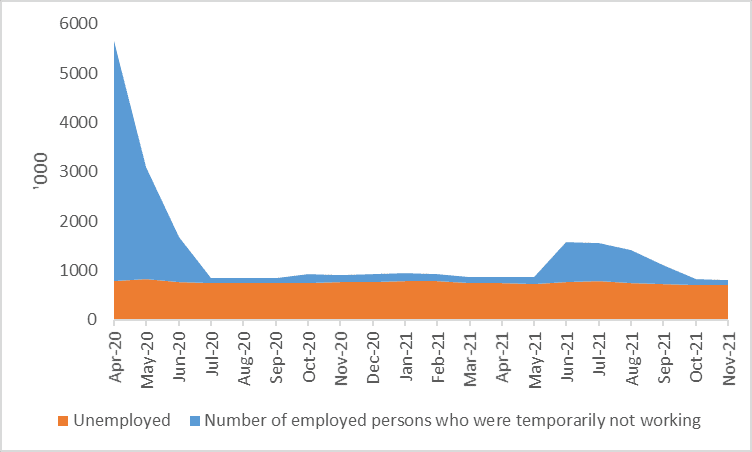
Starting with the first MCO, DOSM began adding to their monthly employment report an estimate of the number of people who still had jobs, but for whatever reason were unable to work. It's a bit of a catch-all category, and includes those with pay as well as those without. Nevertheless, the numbers were initially staggering:


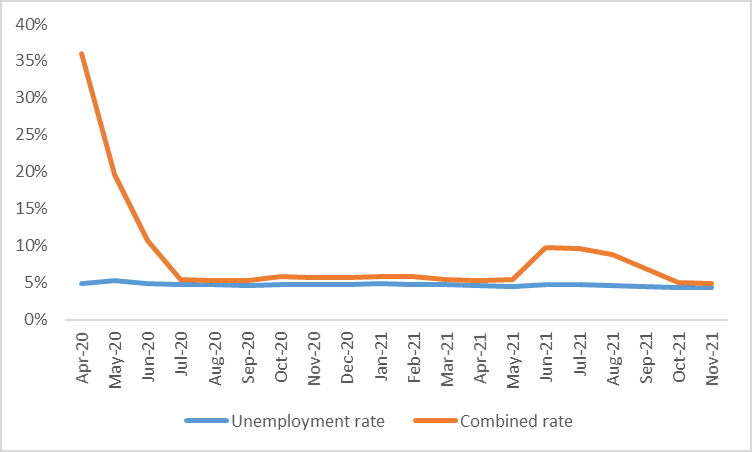
At the peak in April 2020, the number of people in this category numbered nearly 4.9 million, over and above the 778k unemployed. If you put the numbers together, about 36% of the labour force were out of work during the first weeks of the first MCO:


During the 2nd extended MCO last year, the combined rate rose up again to reach 9.8%. This mini bump alone exceeded the worst of the 1980s recession, and more than triple the rate seen during the Asian Financial Crisis in 1998. Thankfully, the latest data shows significant improvement, with unemployment dropping below 700k for the first time since March 2020, and the temporary category dropping to 112k.

May we never see anything like this again.

Friday, February 4, 2022

Silly Stagflation?

A reporter messaged me the other day. With inflation rising, there was apparently concern in "some quarters" that we could see deflation in 2022. My rather flippant reply was that this was silly, which of course, the next day he reported verbatim. While I regret the flippancy, I'll stand by the analysis.

Stagflation is an environment when you have simultaneously high inflation and high unemployment (implying an economy in recession), which makes a policy response a matter of damned if you do and damned if you don't. Bringing down inflation would slow the economy further, raising unemployment; trying to reduce unemployment would fuel faster inflation. This supposed relationship between inflation and unemployment is embodied by the Phillips curve, named after its inventor, AW Phillips. I won't get into the history of that right now, but suffice to say that its not quite that straightforward.

Thursday, February 3, 2022

Reset and Reflections

A long long time ago in a galaxy far far away...I started this blog. It's been 13 years to the day that my first post went live. I never dreamed when I started that it would take me on such a strange wonderful journey, down paths I never dreamed of going down. Blogging has brought me professional success and recognition, and put me in touch with many talented and intelligent people that have enriched my thinking and my life. It's been at turns illuminating, exhilarating, exasperating and frightening. All this from just a desire to openly express my thoughts on that driest of subjects, economics.

Three years ago, I took a decision to step back. I'd reached a point where I thought I'd said all I wanted to say. I'd also just lost my father, I was working in a new role with significantly larger responsibilities, and I also started taking better care of myself, working out to keep fit. All this took a toll on my time and energy. It felt like it was time to let younger and fresher voices to take on the challenges of the present. I thought my time had passed.

But that itch to write has never left. Blogging was a daily part of my routine for over ten years, and lately that itch has started growing again. So time and responsibilities permitting, I'm going to start writing again.

The past two years of dealing with a pandemic has accelerated a growing trend towards reexamining and reassessing many of the cherished foundations of economics, both macro and micro. There has never been a more exciting time to be an economist in recent memory. What started off as a questioning of the orthodoxy during the GFC has morphed with Covid into a battle of ideas we have not seen since the heyday of Keynes and Hayek. I want to put in my 2 cents worth.

So, hello world. Again.

Friday, July 5, 2019

Income Mobility and Needs-Based Targeting

So much for writing regularly again. No sooner did I commit to it, I got loaded with a whole load of extra responsibilities. As a result, the last 2-3 months have been a blur, and I only now feel like I can sit down and reflect a little. That and because I have something to say.

There's a very quiet public policy debate going on about the extent of social assistance the public sector should provide. The overwhelming majority, in part driven by distaste of the policies of the previous BN government, is to roll back cash transfers and institute tighter targeting of benefits, with a particular focus on the poor. My view on this is:

  1. Don't throw the baby out with the bath water; and
  2. Targeting the poor suffers the same problems as targeting any income-based subset of the population (like the B40)

Thursday, March 21, 2019

The Ugly Secret About Needs-Based Poverty Eradication: It Doesn't Work

Nicholas Freeland takes us through the preconditions needed for poverty targeting to work (excerpt):

Poor targeting: a response to Pathways’ paper on how best to reach those in poverty

In an ideal world, poverty targeting would be sensible, which is why it intuitively appeals to those who are new to social protection, or who don’t understand the true complexities of poverty. I would even go so far as to accept that, if all of five conditions were met, there are circumstances in which poverty targeting might be the optimal choice. But we don’t live in an ideal world, and Development Pathways’ paper clearly demonstrates how very unlikely it is – in the real world – to fulfil each one of those five conditions, let alone meet all five simultaneously!

For poverty targeting to be the best option, all of the following five assumptions need to hold true:

  • The poor represent a small residual group;
  • The poor will remain poor (and the non-poor will remain non-poor);
  • Inequitable outcomes are acceptable;
  • The resource envelope is fixed; and,
  • You can accurately identify the poor.

Wednesday, March 20, 2019

The CPI and the Cost of Living: Cross Country Comparisons

This is hopelessly unscientific, but it's an interesting exercise, and is a useful starting point for understanding what goes into the cost of living. So what I have here are comparisons of the weights in the CPI for various countries in comparison with Malaysia, selected from a set of relatively large countries with roughly (±10%) the same level of PPP-adjusted GDP per capita (as per the CIA's World Factbook). The CPI weights are taken from national sources (Malaysia, Poland), Haver Analytics (Mexico), or the IMF (Greece, Hungary, Portugal, & Turkey), and grouped according to the UN's Classification of Individual Consumption According to Purpose (COICOP).

Friday, March 15, 2019

Talking About Belanjawanku

I was on BFM yesterday, talking about UM's new Belanjawanku reference budget:


One thing I should have mentioned/emphasised more is the splendid work done by Prof Datuk Dr Norma Mansor and her team at the Social Wellbeing Research Centre in coming up with it. You can also hear her talking about it here:


Wednesday, March 6, 2019

The CPI Is Not A Cost Of Living Index (And Shouldn't Be Treated As One)

With all due respect to the Minister, I think he gets it wrong here (excerpt):
Minister: New index to reflect ‘real’ cost of living
KUALA LUMPUR, March 5 — The Domestic Trade and Consumer Affairs Ministry is confident that a new cost of living index can reduce the people’s cost of living, especially in the context of the price of goods.

Its minister Datuk Seri Saifuddin Nasution Ismail said the current Consumer Price Index (CPI) was not reflective of the real cost of living, especially for the price of goods.

He said the new index would guarantee and identify more accurately readings on price of goods and cost of living.

“All these while, we (the government) have relied on the CPI or inflation index. For example, the CPI or inflation index can be very low, but then it might not be felt by the people in real life.

“So, we (the government) feel that the new index is a necessity to be made the new guideline that will paint a true picture of what is happening,” he told reporters after officiating the 2018 Excellent Service Award here today.

The problem is the assumption that the CPI is a COL index. It isn’t, or at best, it’s a limited subset of a COL index. First understand what a consumer price index actually does – it tracks a fixed basket of consumer goods and services over time. The goods and services included in the index are based on surveys tracking what people actually spend on. Follow-on surveys are conducted to update the basket, again based on what people actually spend on. So the idea that it doesn’t accurately reflect actual prices of goods is a non-starter.

Here’s where the CPI diverges from a COL index – first, since the CPI averages data across the whole country, it would naturally gloss over differences between areas and regions. Given the disparities in income and expenditure between urban and rural on one hand, and differences in tastes and preferences geographically on the other, it’s no surprise that the national CPI would diverge from individual and regional experiences of inflation.

Second, the CPI is laser focused on consumer goods and services, and ignores capital expenditure. Specifically, it only models the consumption portion of housing (in Malaysia, cars are assumed to be “consumption” items), and ignores housing equity. As a result, the CPI includes rent and imputed rent, but not changes in house prices. Mortgage payments would include elements of rent (consumption use and effectively the opportunity cost of buying a house), home equity (the value of the house over and above it’s consumption use), and interest, but only the first element is a part of the CPI (for a more detailed discussion, see here).

I have to keep pulling out this chart to illustrate what I mean (I know it’s a little out of date, but I’m too lazy to dig up the data again):


The increase in the cost of home ownership has exceeded almost every other item in the household budget, including food and petrol.

As a result, the CPI will never be an accurate measure of the cost of living, because it excludes a very major portion of people’s budgets, especially since the home ownership ratio in Malaysia is fairly high. However, this is not equivalent to saying that it is not a good measure of consumer inflation, because all the empirical research on it suggests that it actually does a decent job of it. If anything, the methodology of constructing the CPI results in it usually over-stating inflation, not under-stating it. The problem here is that the cost of living is a mix of both consumer prices (which the CPI tracks) as well as asset prices (which the CPI doesn't).

But saying the CPI isn’t a good measure of the cost of living is like saying my cat is a bad dog because it won’t bark. We're really talking about different animals here.

Tuesday, March 5, 2019

Belanjawanku

So I was at the launch yesterday, moderating the panel session after all the speeches. So far, the reception to the guide has been…interesting, to say the least. But since the media gave little attention to the panel discussion, I though I’d set out what topics were discussed. Not that we had any definitive answers, but then part of the motivation for publishing this thing in the first place was to raise awareness. So these were the 3 main themes that I gave to the panel: