Showing posts with label Pigovian tax. Show all posts

Wednesday, August 9, 2017

Chart of the Week: RON95 Petrol Price Vs Volume

Malaysian consumers mostly responding to price signals (quarterly MYR average prices, log annual and quarterly changes):

01_ron95

When the administered RON95 price was raised in 2013, there was little change in demand growth. It was still running at roughly 5% per annum. However, when the oil price drop in 2014 started feeding through into retail petrol prices, there was a steep rise in demand. A bit of an oddity, considering that the economic situation was less than ideal – or maybe it was because outbound tourism became more expensive, so people took to domestic travelling more.

In any case, the volume has lately become much more sensitive to prices (a signalling effect from monthly/weekly price volatility? worth keeping track of). For 1Q17, there was a sharp drop-off in purchases of petrol. From my point of view that’s ideal – a Pigovian tax on petrol (like tacking on GST) would then have the desired effect on consumer behaviour.

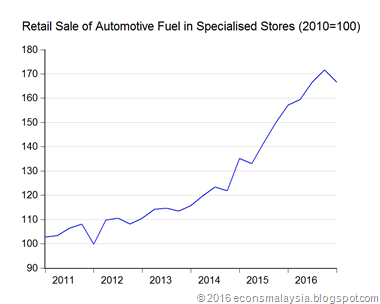
One thing the charts above don’t show however, is just how much petrol Malaysians are consuming. It’s sobering (index numbers; 2010=100):

02_volume

Consumption of petrol is 70% higher than it was in 2010, and 2/3rds of the increase has come over the past three years alone.

Technical Notes:

  1. RON95 retail prices from Galvin Tan’s blog and press anouncements
  2. Retail fuel volume data from the Quarterly Distributive Trade Index reports from the Department of Statistics

Tuesday, January 26, 2016

Pigovian Taxes: Are We Finally Ready For It?

This past week, I met up with a senior official at MOF, and he surprised me by supporting a resumption of duty on petrol (via GST). Relief had been granted for RON95 since GST was implemented, and before that, relief from sales tax had already been in force for years.

It turns out he (and I) are not alone:
Debate on petroleum tax
Amidst the falling price of crude, a question that is being debated by some within and outside the Government is whether there should be a tax on petrol.
The current automatic pricing mechanism (APM) for determining petrol prices comprises multiple components, including product costs, operation costs, vendor margins and a tax, among others.
Notably, the current managed float system is based on monthly reviews on the APM based on prevailing crude oil prices and the margins enjoyed by petrol dealers are closely monitored by the government.
Before the APM came into place, for each litre of petrol the tax portion was 58 sen.
However because of the high oil price, the government did not collect the tax and instead subsidised petrol to keep prices low.
Now the question being asked is whether the Government should reduce its relief on RON97 since petrol is a consumption item and involves draining the natural resources....
The discussion is starting to surface, though I would have been happier if this was pushed through in stronger economic times. Has the time finally come for doing the right thing?

Friday, October 3, 2014

Subsidy Cut

So, effective yesterday, petrol prices at the pump have been raised to RM2.30 and diesel to RM2.20.

Ballsy move, and to me, completely unexpected. With the 20sen cut in the petrol and diesel subsidy, Malaysia is within striking distance of abolishing fossil fuel subsidies entirely – at least, at the retail level. We still have the gas subsidy to deal with, but that’s less important for a couple of reasons: gas is a cleaner fuel (no negative externalities) and there’s also less implications for the government budget.

Resistance, compared to the similar 20sen cut last year, seems to me to be a lot more muted this time around. Nevertheless, resistance there is.

Tuesday, April 9, 2013

Penurunan Harga Kereta Disokong Analisa Ekonomi, Tetapi Peningkatan Subsidi Petrol Tidak

[This is a translation of a previous post that originally appeared in English, on request of a reader (original post here). I’m NOT going to take such requests very often, because translating some of the technical language from English to Bahasa is painfully laborious, and because for the sake of coherence this is not a direct translation. Feel free to send in requests anyway, but NO promises. A big thank you to my wife for a bang up job of editing my original translated text]

Salah satu topik yang hangat baru-baru ini ialah harga kereta yang mahal di Malaysia, satu isu yang telah diutarakan dalam Manifesto Pilihanraya Pakatan Rakyat. Seperti yang kita sedia maklum, industri kereta nasional telah lama dilindungi daripada persaingan asing melalui pengenaan duti eksais ke atas semua kereta impot samada yang dipasang diluar atau dalam Negara.

Walaupun dasar memperlindungi industri tempatan daripada saingan asing ada buruk-baiknya, perlindungan ini mempunyai kesan jelas pada harga kereta impot di Malaysia berbanding negara-negara lain. Sebagai contoh, Honda Civic di Malaysia harganya bermula dari kira-kira RM120k kepada lebih RM130k. Kereta yang sama boleh dibeli diantara USD18k (atau RM54k)dan USD28k (atau RM84k) di Amerika Syarikat. Pada kadar pertukaran Ringgit semasa, perbezaan harga ini adalah antara kira-kira 50% hingga 110% lebih tinggi di Malaysia daripada di AS. Walaupun mengambil kira perbezaan dalam harga jualan kepada pengguna (variasi enjin, insurans, aksesori, tahap trim dll), jurang perbezaannya masih lebih besar daripada yang berpatutan. Di rantau ini, hanya Singapura mempunyai harga kereta yang lebih tinggi.

Tuesday, March 26, 2013

What If Everyone Had A Car?

I’m on my hobby horse today. From the BBC:

What if everyone had a car?

Technology offers potential solutions to traffic congestion and pollution – but getting there will take time, R&D dollars, and an incentive for people to make the shift to smaller, more fuel efficient vehicles.

For starters, how about getting rid of subsidies and taxing petrol use?

Wednesday, March 13, 2013

Cheaper Cars Makes Economic Sense; Cheaper Gas Doesn’t

An acquaintance asked me the other week when I was going to bash Pakatan Rakyat’s Manifesto. I don’t know that bashing would be the right word – I’d prefer “constructive criticism” – but I suppose this post will come close.

One of the hotter topics to arise in the last six months has been the price of cars. In Malaysia, of course, the national car industry has been protected by an excise duty on imports and non-“national” cars, even those assembled locally.

Wherever you stand on the desirability of industrial policy, this has had the obvious effect on car prices – cars in Malaysia retail for more than in other countries. For example, the Honda Civic in Malaysia ranges from about MYR120k to over MYR130k, but goes for between USD18k to USD28k in the United States.

At today’s exchange rates, that amounts to a difference of between about 50% to 110% higher. Even allowing for differences in on-the-road pricing (engine variations, insurance, accessories, trim level etc), the difference still amounts to a hefty chunk of change. In this region, only Singapore has higher prices.

Tuesday, May 15, 2012

Subsidy Reform: Same Problems Worldwide, Same Solutions?

File under the to-do list for after the election (whenever that happens to be):

Costly Mideast Subsidies Need Better Targeting
IMF Survey online

  • Generalized price subsidies are often costly, inefficient
  • Targeted social safety nets give better support, allow more priority spending
  • Subsidy reform should be among steps to cut poverty, boost inclusive growth

Many governments across the Middle East and North Africa (MENA) provide substantial energy and food price subsidies to their populations to offer some relief from high commodity prices or to share the wealth from natural resources.

These well-intended social protection policies are increasingly weighing on government budgets and debt levels and are not necessarily the most efficient way to channel aid to the most vulnerable, participants at a recent IMF seminar said…

Friday, January 13, 2012

More On Dropping The Petrol Subsidy

There is, as one commentator put it, more than one way to kill [sic] a cat. I’ve been open about my support for dropping petrol subsidies in favour of taxes which cover the overall costs to society imposed by fossil fuel use i.e. a Pigovian tax.

There’s actually some method to my madness.

Friday, October 21, 2011

The Argument For Taxing Energy

N. Gregory Mankiw points us to this article by Yale Professor William Nordhaus:

Energy: Friend or Enemy?
William D. Nordhaus

...The two faces of energy are the primary reason why energy policy is so controversial and tangled. We need national policies that address the enemies of pollution and global warming. But because energy is such a large part of consumer budgets and so central to our advanced economies, people are reluctant to allow energy prices to reflect the true social costs of energy consumption. We see this tradeoff play out in energy and environmental policy year in and year out...

...An externality is an activity that imposes uncompensated costs on other people. Externalities from energy use include the deadly air pollution emitted by cars and power plants, oil spills, radioactive emissions from nuclear power plants, sludge from coal mines, and congestion from overloaded streets and highways. More recently, scientists have focused on greenhouse gas emissions, such as the carbon dioxide that comes from burning fossil fuels, as a particularly dangerous externality...

Sunday, December 5, 2010

Round 2 Subsidy Rationalisation

I almost missed this one (been out of town the whole day):

New subsidy cuts to save RM1.2bil

PUTRAJAYA: The prices of Ron95 and diesel have increased by 5sen per litre while liquefied petroleum gas (LPG) and sugar will go up by 5 sen per kg and 20sen per kg respectively.

Minister in the Prime Minister’s Department Datuk Seri Idris Jala said that the price hikes, effective midnight yesterday, were expected to result in a total savings of RM1.18bil.

He said the savings would be channelled towards the Government Transformation Programme including improving the urban transportation network, rural basic infrastructure and roads, education and efforts to combat crime.

Tuesday, November 2, 2010

RON97 Petrol Up 5 sen From Today

Unlike the subsidised price of RON95 petrol, RON97 is apparently priced according to a “automatic pricing mechanism”:

RON 97 price up 5 sen and reflects global petrol market price

KUALA LUMPUR: The price of RON 97 is up 5 sen to RM2.15 per litre from Tuesday and reflects the price of petrol in the global market, said Deputy Domestic Trade, Co-operative and Consumerim Minister Datuk Rohani Abdul Karim.

The price of the more widely used RON 95 remains at RM1.85 per litre.

"It was announced on July 16 that the price of Ron 97 will be subjected to a managed float,'' she said this in her reply to Dr Dzulkefly Ahmad (PAS - Kuala Selangor) during Question Time.

A market oriented mechanism is superior to price controls. But even this isn’t sufficient to offset the negative externalities (pollution, congestion, etc) arising from the use of fossil fuels.

Please, tax the stuff.

Friday, October 29, 2010

The Efficiency of Taxation: Save The Environment, Tax Petrol

Part of the new budget proposals was a tax break for “hybrid” cars, which use both petrol and electrical-driven engines to achieve heretofore unheard of fuel economy. But is this a good idea? Not so much in terms of encouraging the adoption of “green” vehicles, but rather in terms of whether this is actually the best deployment of the government’s financial resources.

In any case, others are talking about further measures along the same vein:

Monday, June 7, 2010

Mankiw On Pigovian Taxes

I believe, given the costs to Malaysian society that come from excess consumption of sugar, that not only should subsidies and price controls on it be dropped but that it should also be taxed as well. The argument goes double for petrol, as the impact on society and the environment are that much greater.

N Gregory Mankiw provides both sides of the debate in this NYT article (excerpts):

Can a Soda Tax Save Us From Ourselves?

AS governments large and small face sizable budget shortfalls, policy makers are looking for ways to raise tax revenue that will do the least harm and, perhaps, even a bit of good. One idea keeps popping up: a tax on soda and other sugary drinks…

…Economists have often advocated taxing consumption rather than income, on the grounds that consumption taxes do less to discourage saving, investment and economic growth. Hence the case for broad-based consumption taxes, like a value-added tax. The main issue for the soda tax, however, is whether certain forms of consumption should be singled out for particularly high levels of taxation.

One argument for specific taxes is that consuming certain products has an adverse impact on bystanders. Economists call these effects negative externalities.

Taxes on gasoline can be justified along these lines. Whenever you go out for a drive, you are to some degree committing an antisocial act. You make the roads more congested, increasing the commuting time of your neighbors. You increase the likelihood that other drivers will end up in accidents. And the gasoline you burn adds to pollution, including the greenhouse gases thought to cause global climate change.

Many economists advocate gasoline taxes so that drivers will internalize these negative externalities. That is, by raising the price of gasoline, a tax would induce consumers to take into account the harm they cause after making their purchases. One prominent study added up all the externalities associated with driving and concluded that the optimal gasoline tax is over $2 a gallon, about five times the current level (combining the federal and a typical state’s levies) and about the tax rate in many European countries.

Applying that logic to other consumer goods, however, is not as straightforward. Consider cigarettes. They are among the economy’s most heavily taxed products, as governments try to discourage people from smoking. Yet the case for such a policy cannot rely on a conventional externality argument.

When a person sits at home and smokes two packs a day, the main adverse impact is on his or her own health. And even if second-hand smoke is a concern, that problem is most naturally addressed within the household, not at the state or federal level.

Sometimes, advocates of “sin” taxes contend that consumers of certain products impose adverse budgetary externalities on the rest of us — that if the consumption induces, say, smoking- or obesity-related illness, it raises health care costs, which we all pay for through higher taxes or insurance premiums.

Yet this argument has a flip side: If consumers of these products die earlier, they will also collect less in pension payments, including Social Security. Economists have run the numbers for smoking and often find that these savings may more than offset the budgetary costs. In other words, smokers have little net financial impact on the rest of us…

…There is, however, an altogether different argument for these taxes: that when someone consumes such goods, he does impose a negative externality — on the future version of himself. In other words, the person today enjoys the consumption, but the person tomorrow and every day after pays the price of increased risk of illness.

This raises an intriguing question: To what extent should we view the future versions of ourselves as different people from ourselves today?

…But people do not suddenly mature at the age of 18, when society deems us “adults.” There is always an adolescent lurking inside us, feeling the pull of instant gratification and too easily ignoring the long-run effects of our decisions. Taxes on items with short-run benefits and long-run costs tell our current selves to take into account the welfare of our future selves.

IF this is indeed the best argument for “sin” taxes, as I believe it is, we are led to vexing questions of political philosophy: To what extent should we use the power of the state to protect us from ourselves? If we go down that route, where do we stop?

Taxing soda may encourage better nutrition and benefit our future selves. But so could taxing candy, ice cream and fried foods. Subsidizing broccoli, gym memberships and dental floss comes next. Taxing mindless television shows and subsidizing serious literature cannot be far behind.

Even as adults, we sometimes wish for parents to be looking over our shoulders and guiding us to the right decisions. The question is, do you trust the government enough to appoint it your guardian?

N. Gregory Mankiw is a professor of economics at Harvard.

I think from my point of view, that the answer to that philosophical question is this: you apply taxation or subsidies when the public costs or benefits are large and obvious. That’s one basic argument for the provision of public goods like healthcare and defence, and for monopolies like rail and electricity generation. Taxing sugary foods and drinks might not meet that criteria, but taxing sugar itself does.

Thursday, May 27, 2010

Subsidy Rationalisation Lab Open Day

I attended the Open Day this morning on invitation from PEMANDU (or rather my company got invited and I was one of the truckload that got picked to go).

You can find Dato’ Sri Idris Jala’s presentation on the PEMANDU website (warning: pdf link).

Now we know where this RM74 billion figure being bandied about comes from. It includes not just officially designated subsidies, but also Petronas’ spending on the gas subsidy (which isn’t carried on the government accounts), as well as spending on education, healthcare and social services, which aren’t necessarily subsidies as the term is commonly used.

The rest of my thoughts on the subject:

  1. I think for the most part the rationalisation plan is sensible – in the political sense, though not necessarily in the economic sense. Spreading the pain over 3-5 years means less citizen anger, and gives the government time to formulate and implement a better social welfare policy – I’m not sure the mitigation proposals contained in the rationalisation plan go far enough to ensure that the subsidies that remain or newly introduced will offset the impact on the poor and lower income groups.
  2. There was a lot of general support for getting rid of consumer subsidies, especially on sugar (the stats on obesity and diabetes in the open day exhibition were truly frightening) where there were a few proposals from the floor in favour of immediate abolishment rather than phased in over 3-5 years. In this case, I think we have to take the next logical step – if sugar consumption has negative social welfare impact, then removing subsidies only partly compensates for the social costs (treatment of diabetics, healthcare for the obese and overweight). That means there’s actually a strong argument for taxing sugar as well as removing the subsidy on it.
  3. And if you buy that argument, then it goes ten-fold for petrol and other use of carbon fuels, because the environmental and social impact is so much greater. If you consume too much sugar, the costs are largely borne yourself, and partly on society through higher healthcare costs. Pollution from carbon fuel burning affects the air we all breathe, not just ourselves. That health costs are less visible, but no less powerful – check the incidence of asthma and bronchitis, not to mention lost work days from illness resulting from pollution (check this post for the basis of my argument).
  4. On the time span for rationalisation, I’m in favour of a shorter rather than a longer period. BNM apparently ran some simulations and came up with a figure of 4% in 2011-12, and back to 3% from 2013-2015 if all the proposals were implemented. To me the problem with a longer period is that you risk unanchoring inflationary expectations – i.e. people will start expecting higher inflation as a matter of course, and that means continuously higher wage demands which feed into higher inflation.  There was one proposal from the floor for the period to be shortened to 24 months – I think that strikes the right balance between spreading the pain and getting it over with as fast as possible. Five years is a long time, especially in politics, and there’s no guarantee that the political will for getting rid of subsidies will last that long. Understand that I’m not arguing against cost of living adjustments to existing wage levels – but rather a self-perpetuating cycle of price increases, which would necessitate a monetary policy response. As it is, I’m already thinking that OPR might go back to 3.5% next year, and even higher in 2012, just to mitigate higher nominal demand.
  5. There was also a lot of talk on education, although I think even the panel discussion missed some basic points. Dato’ Sri Idris mentioned that Malaysia ranks 7th in the world in spending on education per capita. If that’s the case, then the declining standards in maths and science in Malaysia suggests that money isn’t being used as effectively as it should, nor does it explain why tertiary enrollment (<30%) is so low compared to high-income economies (>60%). That’s a qualitative and quantitative issue that has to be addressed.
  6. Apart from a remark by Tan Sri Azman Mokhtar and an observation by YB Tony Pua that the fall in global oil prices meant that there is effectively no subsidy on petrol, there was little to no discussion on what to do if market prices fell below government mandated prices during the rationalisation phase – shall we go to market prices directly? Or some form of adjustment mechanism? Details here would be welcome.
  7. I’m still against the idea of providing substantive support to smallholders and small-scale fishermen. They are not productive, and no amount of technology or incentives are going to make them so. Better to provide living support (just give them cash), until the pace of development overtakes them. I know that sounds callous, but our food and agricultural production will never improve if we only look to perpetuating an existing moribund market structure that cannot survive without government support, instead of rationalising land use and capital into units that can be competitive and productive. This is of course more a political issue rather than an economic one, which is why I doubt there will be much change here.
  8. The panel discussion very nearly turned into an IPP-bashing session, and here’s hoping that there will be some movement in the direction of renegotiating the contracts.
  9. YB Tony also brought up the issue of toll highways, again. Check out his blog for details.

Tuesday, May 25, 2010

Subsidies? How About Raising Petrol Taxes Instead?

One of the key aspects of the NEM, and a vital part of regularising government finance, is reducing and eventually phasing out entirely subsidies, particularly on food and fuel. Some of the figures bandied about, not least by the Prime Minister, are a little too much in la-la land, but the gist of it is clear – the cost of subsidies are too high, they’re not benefiting the target groups as much as they should, and they’re creating perverse economic incentives.

There’s a nice piece on the subject of petrol subsidies in yesterday’s The Star (excerpt):

Malaysians consume more fuel

As Malaysia practises a blanket subsidy on fuel, data made available to the Performance Management and Delivery Unit (Pemandu) subsidy rationalisation lab showed that 71% of fuel subsidy was enjoyed by the middle to high-income level groups.

Some 28% of those enjoying fuel subsidy earn more than RM5,000 per month, while 43% earned between RM2,500 and RM5,000.

Abuse of liquid petroleum gas (LPG), or cooking gas, has also contributed to an inflated subsidy bill. Some RM1.71bil was spent on subsidising LPG, to which only RM397mil or 30% are used by households.

In addition, there’s the rather telling datum that fuel consumption rose 8% in 2008, despite pump prices doubling in that year.

What are the actual subsidy numbers? Officially, based on MOF’s functional classification of expenditure, the government spent RM18.6 billion on subsidies in 2009 and RM35.2 billion in 2008. The historical data is illuminating (RM billions, inflation adjusted; 2000=100):

01_subs Subsidies started climbing in the wake of the 2000 recession, and haven’t stopped since. The killer blow was the climb in commodity prices and the concurrent upswing in food prices in 2008 (remember the rice “shortage”?).

Of course the official figure isn’t the whole story – there’s the hidden gas subsidy at Petronas which ends up as reduced government income from petroleum royalties and corporate taxes; the difference in pricing between what TNB charges against what it has to pay the IPPs; controlled prices on basic food items; as well as whether development spending as a whole can be considered as subsidies, as implied by the PM’s figures. I don’t think any of these are on the table for abolishment just yet.

In any case, the cabinet is meeting tomorrow to discuss the issue, and there will be an open day at KLCC on Thursday to gain public feedback.

The key problem in my view is that the subsidies are directed at consumer prices, rather than targeted at a particular group. This is easier to administer, but from the numbers in the article quoted above, it’s fairly obvious that the actual benefits accrue to everybody, rich and poor alike, corporations as well as individuals. That’s a rather inefficient and expensive way to handle welfare transfers – it’s actually highly regressive i.e. those that benefit the most need it the least.

But getting rid of subsidies isn’t the whole answer, as you still have the negative welfare impact on the poor and lower income groups from higher food and fuel prices. They’d still need some form of support to replace the expenditure lost through higher outlays. Royal Professor Ungku Aziz has suggested a debit card scheme for the hard-core poor, with a monthly token of RM300 for basic food items. Or you can follow some Western practices like food stamps, or outright cash giveaways. Whichever the route we end up following, there’s going to be a call on Government finances and there’s going to have to be some form of administrative framework to manage the scheme i.e. the Government’s going to get bigger.

Now, from the financial perspective funding a social safety net can be derived from savings gained from the abolishment of subsidies. I don’t think that’s going to be a big issue, unless the scheme itself becomes too complex, or the government goes overboard in terms of benefits. You could also argue for an income tax cut, but that would be pretty regressive too as the tax base is so narrow. Alternatively, the reduction in subsidies could be predicated on a lower GST, if and when that comes into play.

However, there’s a hidden aspect particular to petrol and gas that isn’t being addressed – pollution and the concomitant need for healthcare (need I say that the services offered by public hospitals and clinics are also highly subsidised?), known in the economic terminology as negative externalities. Abolishing subsidies on these items would go a long way toward matching supply and demand, but the market price does not address their true economic costs. These become another form of hidden subsidy – increased healthcare costs, pollution cleanup costs, infrastructure delivery costs and more, that are borne not by the users of petroleum products but by everyone.

So I’m firmly of the belief that we ought to tax petrol and gas, not just lift subsidies. That achieves three things – one is to impose the true costs of using petrol and gas on users; secondly, it reduces fuel consumption, the impact on the environment, and encourages conservation; and third the proceeds can be used to help offset the costs of both the social safety net as well as the ancillary costs of the negative externalities arising from the use of petroleum products. It also helps that a Pigovian tax and transfer mechanism of this form will also be far more efficient in terms of raising social welfare and rebalancing incomes. There’s also the secondary effect of increasing pressure to raise pay packets – which is the direction we want to head in anyway.

I’m not blind to the difficulties here. There’s an obvious corollary that the government’s social welfare capabilities needs to be beefed up (it’s awful right now) in terms of manpower, organisation, data collection and funding – which increases the opportunities for waste, mismanagement and corruption. There’s also going to be an outcry from the middle classes, as they have the most to lose (no increase in benefits, but with all the cost).

This isn’t a vote winning proposition, but it is the right and economically correct thing to do.

For Further Reading (from Prof N. Gregory Mankiw):

  1. The Pigou Club Manifesto
  2. Alternatives to the Pigou Club
  3. Smart Taxes: An Open Invitation to Join the Pigou Club (pdf link)