Showing posts with label price controls. Show all posts

Wednesday, August 9, 2017

Chart of the Week: RON95 Petrol Price Vs Volume

Malaysian consumers mostly responding to price signals (quarterly MYR average prices, log annual and quarterly changes):

01_ron95

When the administered RON95 price was raised in 2013, there was little change in demand growth. It was still running at roughly 5% per annum. However, when the oil price drop in 2014 started feeding through into retail petrol prices, there was a steep rise in demand. A bit of an oddity, considering that the economic situation was less than ideal – or maybe it was because outbound tourism became more expensive, so people took to domestic travelling more.

In any case, the volume has lately become much more sensitive to prices (a signalling effect from monthly/weekly price volatility? worth keeping track of). For 1Q17, there was a sharp drop-off in purchases of petrol. From my point of view that’s ideal – a Pigovian tax on petrol (like tacking on GST) would then have the desired effect on consumer behaviour.

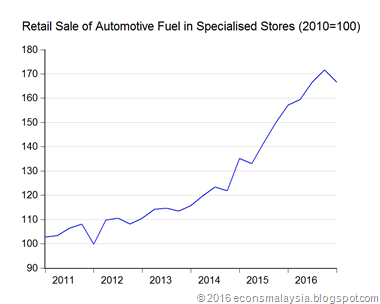
One thing the charts above don’t show however, is just how much petrol Malaysians are consuming. It’s sobering (index numbers; 2010=100):

02_volume

Consumption of petrol is 70% higher than it was in 2010, and 2/3rds of the increase has come over the past three years alone.

Technical Notes:

  1. RON95 retail prices from Galvin Tan’s blog and press anouncements
  2. Retail fuel volume data from the Quarterly Distributive Trade Index reports from the Department of Statistics

Friday, July 29, 2011

Another NKRA…

Decided on in the Wednesday cabinet meeting, we’ve got another National Key Result Area to go along with the six already in place:

PM announces NKRA to deal with rising cost of living

PUTRAJAYA: The cabinet decided Wednesday to add another National Key Result Area (NKRA) to the list of six to make it seven altogether.

Prime Minister Datuk Seri Najib Tun Razak said the new NKRA dealt with the rising cost of living...

...Najib said the government would leverage the expertise of Pemandu to assist the relevant ministries and agencies as well as the Cabinet Committee on Supply and Price headed by Deputy Prime Minister Tan Sri Muhyiddin Yassin.

Sunday, December 5, 2010

Round 2 Subsidy Rationalisation

I almost missed this one (been out of town the whole day):

New subsidy cuts to save RM1.2bil

PUTRAJAYA: The prices of Ron95 and diesel have increased by 5sen per litre while liquefied petroleum gas (LPG) and sugar will go up by 5 sen per kg and 20sen per kg respectively.

Minister in the Prime Minister’s Department Datuk Seri Idris Jala said that the price hikes, effective midnight yesterday, were expected to result in a total savings of RM1.18bil.

He said the savings would be channelled towards the Government Transformation Programme including improving the urban transportation network, rural basic infrastructure and roads, education and efforts to combat crime.

Wednesday, June 30, 2010

This Isn’t The Purpose Of Government

From today’s Star (excerpt):

Sugar supply to be increased from Thursday

The Government will add 10% more sugar supply to wholesalers and retailers nationwide from this Thursday until September, said Domestic Trade, Cooperatives and Consumerism Minister Datuk Seri Ismail Sabri Yaakob.

"The additional supply is to meet the high demand for sugar, especially during the coming festive season," he said when winding up the debate on the 10th Malaysia Plan for his ministry in the Dewan Rakyat, here, Tuesday.

Early this month, the Government added 5% to the sugar supply to meet the current demand.

Ismail Sabri said to ensure sufficient sugar supply always, the Government had appointed the relevant associations to supply and distribute the essential commodity to their members.

The government has a positive role in lot of things that impact society, from healthcare, to defense, to education – but acting as a sugar daddy shouldn’t be one of them.

Sadly this is a major consequence of having administered prices – because the tendency is to set prices below the market clearing level (and ours is somewhere about a third below that level), you’re always ending up with a shortfall in production and supply. Which in turn means spending money on securing an imported source to cover the deficit. The flip side of that is because sugar is cheaper than it should be, consumption is also higher than it should be.

The problem with sugar is that, unlike salt, it’s really hard to figure out if you’re taking too much. So this higher consumption is in part going towards over-sweet processed foods, which in all probability would probably taste just as good with less sugar in the mix.

From a socio-economic perspective, the subsidy and price controls on sugar are indefensible. Let’s get rid of them now, please. And while we’re at it, let’s slap a tax on sugar that would help cover its true economic cost in helping foster obesity, diabetes, heart disease and high blood pressure.

Monday, June 7, 2010

Mankiw On Pigovian Taxes

I believe, given the costs to Malaysian society that come from excess consumption of sugar, that not only should subsidies and price controls on it be dropped but that it should also be taxed as well. The argument goes double for petrol, as the impact on society and the environment are that much greater.

N Gregory Mankiw provides both sides of the debate in this NYT article (excerpts):

Can a Soda Tax Save Us From Ourselves?

AS governments large and small face sizable budget shortfalls, policy makers are looking for ways to raise tax revenue that will do the least harm and, perhaps, even a bit of good. One idea keeps popping up: a tax on soda and other sugary drinks…

…Economists have often advocated taxing consumption rather than income, on the grounds that consumption taxes do less to discourage saving, investment and economic growth. Hence the case for broad-based consumption taxes, like a value-added tax. The main issue for the soda tax, however, is whether certain forms of consumption should be singled out for particularly high levels of taxation.

One argument for specific taxes is that consuming certain products has an adverse impact on bystanders. Economists call these effects negative externalities.

Taxes on gasoline can be justified along these lines. Whenever you go out for a drive, you are to some degree committing an antisocial act. You make the roads more congested, increasing the commuting time of your neighbors. You increase the likelihood that other drivers will end up in accidents. And the gasoline you burn adds to pollution, including the greenhouse gases thought to cause global climate change.

Many economists advocate gasoline taxes so that drivers will internalize these negative externalities. That is, by raising the price of gasoline, a tax would induce consumers to take into account the harm they cause after making their purchases. One prominent study added up all the externalities associated with driving and concluded that the optimal gasoline tax is over $2 a gallon, about five times the current level (combining the federal and a typical state’s levies) and about the tax rate in many European countries.

Applying that logic to other consumer goods, however, is not as straightforward. Consider cigarettes. They are among the economy’s most heavily taxed products, as governments try to discourage people from smoking. Yet the case for such a policy cannot rely on a conventional externality argument.

When a person sits at home and smokes two packs a day, the main adverse impact is on his or her own health. And even if second-hand smoke is a concern, that problem is most naturally addressed within the household, not at the state or federal level.

Sometimes, advocates of “sin” taxes contend that consumers of certain products impose adverse budgetary externalities on the rest of us — that if the consumption induces, say, smoking- or obesity-related illness, it raises health care costs, which we all pay for through higher taxes or insurance premiums.

Yet this argument has a flip side: If consumers of these products die earlier, they will also collect less in pension payments, including Social Security. Economists have run the numbers for smoking and often find that these savings may more than offset the budgetary costs. In other words, smokers have little net financial impact on the rest of us…

…There is, however, an altogether different argument for these taxes: that when someone consumes such goods, he does impose a negative externality — on the future version of himself. In other words, the person today enjoys the consumption, but the person tomorrow and every day after pays the price of increased risk of illness.

This raises an intriguing question: To what extent should we view the future versions of ourselves as different people from ourselves today?

…But people do not suddenly mature at the age of 18, when society deems us “adults.” There is always an adolescent lurking inside us, feeling the pull of instant gratification and too easily ignoring the long-run effects of our decisions. Taxes on items with short-run benefits and long-run costs tell our current selves to take into account the welfare of our future selves.

IF this is indeed the best argument for “sin” taxes, as I believe it is, we are led to vexing questions of political philosophy: To what extent should we use the power of the state to protect us from ourselves? If we go down that route, where do we stop?

Taxing soda may encourage better nutrition and benefit our future selves. But so could taxing candy, ice cream and fried foods. Subsidizing broccoli, gym memberships and dental floss comes next. Taxing mindless television shows and subsidizing serious literature cannot be far behind.

Even as adults, we sometimes wish for parents to be looking over our shoulders and guiding us to the right decisions. The question is, do you trust the government enough to appoint it your guardian?

N. Gregory Mankiw is a professor of economics at Harvard.

I think from my point of view, that the answer to that philosophical question is this: you apply taxation or subsidies when the public costs or benefits are large and obvious. That’s one basic argument for the provision of public goods like healthcare and defence, and for monopolies like rail and electricity generation. Taxing sugary foods and drinks might not meet that criteria, but taxing sugar itself does.

Price Controls and Subsidies Distort Markets: Sugar Edition

From today’s Star (excerpts):

Sugar woes

PETALING JAYA: There is an acute shortage of sugar in the country.

Consumers and traders in several states have voiced their frustration in getting supply of the essential commodity, describing the shortage as the “worst so far”.

A check at several grocery shops here revealed that no sugar had been on sale for over a week…

…Fomca secretary-general Muhd Sha’ani Abdullah said it had received complaints in various areas including Kuantan, Muar, Klang and Temerloh since a month ago.

He said the problem was not due to retailers hoarding sugar but the smuggling of the item to other countries, especially Thailand.

Federation of Sundry Goods Merchants president Lean Hing Chuan said the shortage nationwide was caused by manufacturers halving production, adding that its members started noticing the slowdown in April.

“Factories might be slowing down their production to keep their costs down until subsidies for sugar are withdrawn,” Lean said.

It’s hard to describe in words, so here’s the classical theory (Econ 101)in graphical form (I’m learning how to use Paint!):

equilibrium The vertical axis represents price, while the horizontal axis  represents volume. The “A” (blue) line represents the supply schedule i.e. the volume that producers are willing to supply at any given price. As the price goes up, producers are willing to produce and supply more of a good to the market. The “D” (red) line represents the amount that consumers are willing to buy at any given price. As price goes up, people are less willing to consume a particular good, or equivalently, less people are able to afford a particular good. In either case, demand falls as price rises. P1 represents the prevailing equilibrium price at which demand exactly meets supply, and volume of X1 is transacted between producers and consumers.

So far so good – this is a fairly common sense view of what happens in the market for any “normal” good. The underlying assumptions are of course that there are many producers who are able to instantaneously adjust production according to price and demand, there are no barriers to market entry for either producers or consumers, the market and the price are visible and accessible to all, and there are no transactions costs. You can drop any or all of these assumptions without necessarily detracting from the insights gained from the subsequent analysis.

So what happens when the government provides a production subsidy? Since a subsidy reduces the cost of production, the entire supply schedule shifts to the right and down:
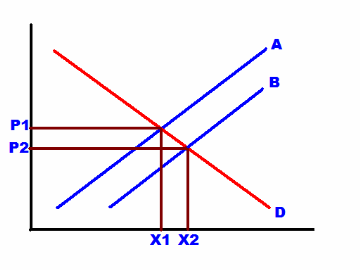
subsidy The supply schedule “A” drops to “B”, and a new equilibrium price is established at P2 where a volume of X2 is supplied. In the case of sugar, a production subsidy effectively means greater production, a lower market price, and greater consumption relative to the original market equilibrium. As costs of production are lower, more firms are able to enter the market, and marginal firms (those who would otherwise have gone bust because they are inefficient) are able to survive.

So while we have greater production, it is at the cost of misallocation of resources because of the embedded inefficiency of production that is covered by the subsidy. This can actually be calculated by the area of the triangle between the intersections of the price and volume lines, and the demand curve. That area represents a net loss to social welfare, as the money could have been used for more productive uses, or to reduce government spending and thus the tax burden. To put it in more understandable layman terms, the amount of subsidy required per unit of output will almost always exceed the drop in price achieved.

There are also negative externalities involved which are not covered by the market price or production costs, as excess consumption of sugar leads to health costs through a higher incidence of diabetes and obesity.

What happens when price controls are added to the mix? You get a really, really bad distortion of market price, demand and production:

price controls

Let’s say the government puts the price ceiling at P3, which is lower than either the original market price P1, or the subsidy induced price of P2. The retail market price will always converge to P3 – given the demand and supply curves as drawn, the price can never drop below P3, as it is uneconomical for producers to increase supply large enough for the market price to fall lower than that. So at P3, demand zooms to P4 as more and more people can afford to buy sugar, with the concomitant increase in the cost of negative externalities to society in the shape of increasing health costs.

But also at P3, the aforementioned marginal producers are out of the business as even with the subsidy previously given, their cost of production is so much higher. Other producers who could have survived even at the original equilibrium market price are also out of the business, again because their costs now exceeds potential revenues. So we have a contraction in supply to X3 – which means that there will be a permanent excess of demand and a permanent shortfall in supply. The bigger the difference between the equilibrium price (subsidy-supported or original), the bigger the shortfall will be. And the controlled price of sugar in Malaysia is a full third lower than the market price currently prevailing in our neighbours.

The only way for the government to ensure that demand meets supply at price control level P3 is to provide a subsidy that drops the supply curve to the point where the demand schedule meets P3. This is not the equivalent of a price subsidy equal to the difference between P1 and P3, which is what most people think is sufficient, but rather the difference between P4 and P3 which is an order of magnitude higher. Assuming a 45 degree angle for the supply curve, that’s equivalent to double the subsidy level from P1 and P3.

If you add intertemporal lags to changing production output (i.e. assuming a short-term inelastic supply curve), then the level of subsidy would be that much greater, as the slope of the supply curve would be steeper. A subsidy that is less than that provides an incentive for producers to hawk their produce outside the country, as they can gain more revenue for a given supply.

So what you get with production subsidies is an expansion in both supply and consumption, but at the cost of inefficient use of resources and lower productivity. What you get with price controls is much worse, with the spectre of permanently decreasing production and a constant shortfall relative to demand. And as time goes on, the situation deteriorates, as consumers feel “entitled” and as more and more producers quit the industry.

That’s the narrative that’s playing out here in Malaysia today, not just in sugar, but in rice, vegetables, and all the other items that the government cares to cap prices on in the name of consumer protection.