Showing posts with label Unemployment. Show all posts

Tuesday, March 29, 2022

Minimum Wage Revised Part IV: Poor SMEs

I'm going to dive deeper into this topic, because there are a number of inter-related issues that need to be highlighted. The data here comes from the 2016 Economic Census, cross referenced with the subsidiary report on SMEs from the same survey.

Before jumping into how an RM1,500 minimum wage might impact SMEs, let me digress into a discussion of the nature of the capital share of GDP.

The 2020 split on the share of GDP was 37.2% labour and 60.1% capital (the residual is taxes and subsidies). This of course has given rise to accusations of greedy capitalists, which is (a little) unfair. Yes, the capital share in Malaysia is high by developed country standards, but its not out of line with other emerging markets. More importantly, the capital share is not the same thing as the share of income going to the business owner/shareholders.

Monday, March 28, 2022

Minimum Wage Revised Part III: What's the appropriate level?

Despite the government determining the minimum wage to be hiked to RM1,500 by May 1, 2022, there's still debate on whether the timing/quantum of the increase is appropriate. This is partly acknowledged by the government itself, with the qualification that it will not apply to micro enterprises with less than 5 employees.

So what's really appropriate? What's the safe level of minimum wage that will uplift low incomes while preserving employment?

Monday, March 21, 2022

Minimum Wage Revised Part I: Theoretical Considerations

So the government has finally announced a new revision to Malaysia's minimum wage, two years after the last one. This time though, it's a whopping 25% increase to RM1,500, from the RM1,200 in 2020. Even after all these years (nine to be exact), the minimum wage continues to be the subject of a lot of arguments, so I thought I'd lay out some of the theory and Malaysian evidence (such as it is).

First of all, what we learned in Econ 101 is that when you establish a price above that of the market determined price, quantity supplied increases while quantity demanded decreases, and the market does not clear. In the context of labour, this implies higher unemployment, as more people are willing to work, but less employers can afford to take them on. But in empirical studies, this generally does not happen with the minimum wage. Why?

Tuesday, February 8, 2022

Unemployed and Out of Work

I wanted to start a discussion on inflation last night, but it took longer than I thought to compile the data (it's been a while). In the meantime, here's something that's a little unique to Malaysia.

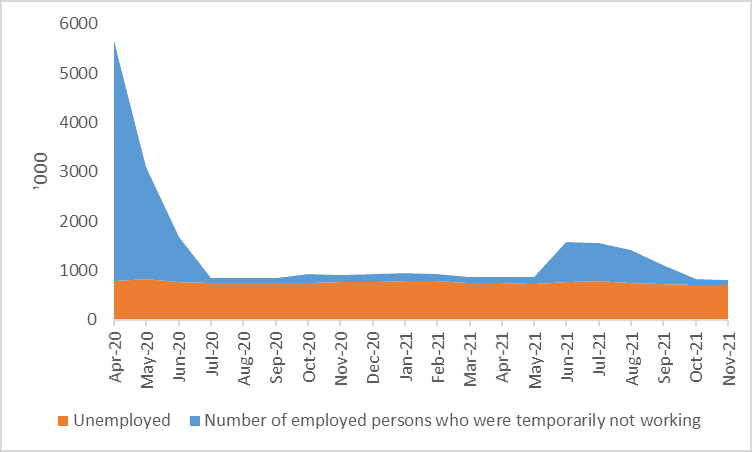
Starting with the first MCO, DOSM began adding to their monthly employment report an estimate of the number of people who still had jobs, but for whatever reason were unable to work. It's a bit of a catch-all category, and includes those with pay as well as those without. Nevertheless, the numbers were initially staggering:


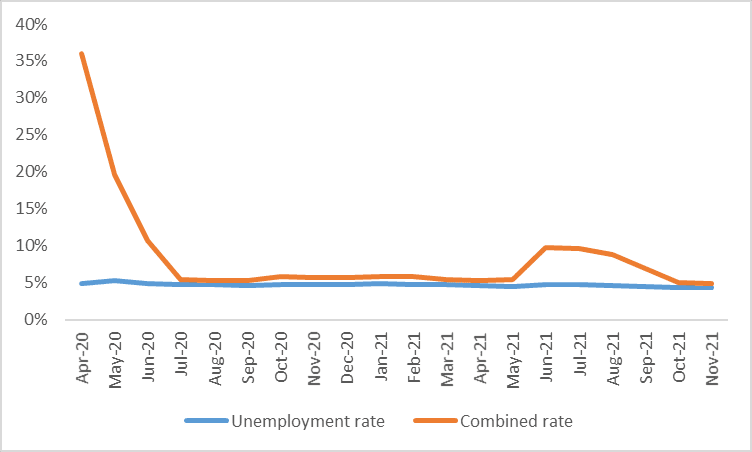
At the peak in April 2020, the number of people in this category numbered nearly 4.9 million, over and above the 778k unemployed. If you put the numbers together, about 36% of the labour force were out of work during the first weeks of the first MCO:


During the 2nd extended MCO last year, the combined rate rose up again to reach 9.8%. This mini bump alone exceeded the worst of the 1980s recession, and more than triple the rate seen during the Asian Financial Crisis in 1998. Thankfully, the latest data shows significant improvement, with unemployment dropping below 700k for the first time since March 2020, and the temporary category dropping to 112k.

May we never see anything like this again.

Thursday, August 3, 2017

EIS estimation

Funny numbers (except):

Employers: Why collect RM1.6b in jobless benefits when retrenchment costs RM300m?

KUALA LUMPUR, Aug 2 — The Malaysian Employers Federation (MEF) has questioned the rationale of collecting an estimated RM1.6 billion annually for the Employment Insurance System (EIS) or over 5 times the compensation for all workers retrenched in the Asian Financial Crisis.

MEF executive director Datuk Shamsuddin Bardan based his calculations on contributions of 1 per cent from both the employer and employee (0.5 per cent each) for an average monthly salary of RM2,000 from 6.8 million private sector workers.

This would amount to about RM1.6 billion a year, while he estimated that unemployment benefits for 50,000 Malaysian workers retrenched during the 1997 crisis would total RM300 million assuming that they received half-month wages based on a RM2,000 salary for six months.

I don’t know where this figure of 50,000 job losses during the AFC comes from. One of the weaknesses of the retrenchment data is that it relies on self-reporting by employers, who don’t exactly have an incentive to report job losses.

So let me just take two industries for which we have detailed data from the economic census. Between 1996 and 2000, the construction sector lost 169k jobs, while manufacturing lost 90k jobs between 1996 and 1999, for a total of 259k jobs. That’s more than five times greater than the MEF estimate, and nearly wipes out the annual inflow.

There’s probably a good argument here for adjusting the contribution to something more realistic, but the difference is not as extreme as MEF thinks.

Friday, February 12, 2016

Managing Risk: TPPA Edition

The treaty document has been out for a couple of months now, and the treaty itself was signed last week. But there's still plenty of opposition to the pact, as we will have another couple of years two go under the ratification process - yup, it still isn't a treaty we have to abide by yet.

In any case, some of that opposition is getting a bit shrill, repeating nostrums that don't really apply any more. Part of the problem is the sheer length of the treaty document; another is the legalese language used.

Take ISDS for example. There seems to be this notion that ISDS would override the ability of governments to regulate, including matters of national interest such as labour laws, health and the environment. That's not true.

Monday, August 4, 2014

Data Releases for July 2014

I’m back from my usual Ramadhan blogging sabbatical. It’s been a bittersweet month – the economy is chugging along better than I ever hoped for and the German demolition of Brazil in the World Cup semifinals was a hoot to watch, but then there was the staggering blow of the MH17 tragedy and the incomprehensible Israeli invasion of the Gaza strip on the very same day. Geo-political risks appear to be increasing, while the global economy remains on a fragile footing, the US recovery notwithstanding.

Wednesday, May 28, 2014

March 2014 Employment

If there’s anything that will tell you the economy isn’t quite as good as the 1Q2014 numbers indicate, it should be employment (‘000):

01_demp

Not to put too fine a point to it, job creation in 1Q2014 sucked – in fact, it’s been pretty poor since the middle of last year.

Monday, April 28, 2014

February 2014 Employment

The February numbers aren’t appealing: employment growth is crashing (‘000):

01_demp

Job creation has been negative in four out of the last five months – a cumulative reduction of about 400k jobs. That’s a serious divergence between the labour force numbers, and the growth of the economy as a whole.

Wednesday, January 22, 2014

November 2013 Employment

Based on the latest report from DOS yesterday, the economy lost 24.1k jobs in November (‘000):

01_demp

However, as I pointed out last month, job losses are fairly typical in October-November, so this is just par for the course. This is confirmed on a seasonally adjusted basis, which shows an increase of 58.9k, i.e. the reduction in the numbers employed was lower than usual.

However, the total labour force didn’t drop as much as last month’s numbers, so the unemployment rate has stayed elevated:

02_unemp

I’m still thinking this is a temporary, seasonal phenomenon, so I’m looking to see the unemployment rate fall back again next month. But if it doesn’t, that might put a damper on all the other positive data that has come out of 4Q2013.

Technical Notes:

November 2013 Employment report from the Department of Statistics (warning: pdf link)

Tuesday, December 24, 2013

Thursday, November 21, 2013

September 2013 Employment

There’s been a dearth of posts on this blog for the past couple of weeks, mainly for two reasons: first, I had some deadlines to meet last week, and second, I took my year end holiday a little early – four days exploring the Forbidden City and climbing the Great Wall of China, among other things. No email, no twitter, no calls from the office…bliss.

Now its back to covering the Malaysian economy, though things will be a little slow as I catch up on data releases, news developments and the backlog of messages and posted comments. My view of 3Q2013 GDP should be out tomorrow (it was released last Friday), but first up is something a little easier to look at.

Wednesday, October 23, 2013

August 2013 Employment

Employment in August rose by 173k (‘000):

01_demp

Some of the increase was due to a lot more people looking for work and finding it (log annual changes):

02_lf_gr

Tuesday, September 24, 2013

July 2013 Employment

The July employment numbers depict a healthy economy, quite at odds with the growth numbers (‘000):

01_demp

Monday, August 26, 2013

June 2013 Employment

Released along with the report on the July CPI was the employment report for June, and it’s certainly at odds with the prevailing market sentiment (‘000):

01_demp

Wednesday, July 3, 2013

What’s Malaysia’s Full Employment Rate?

I honestly don’t know, but our new EPU head thinks its 4% (excerpt):

Parliament: 20 years of full employment, says Abdul Wahid

KUALA LUMPUR: The country's sustainable economic growth over the past 20 years has kept the unemployment rate at below 4 percent, which based on economic definition, is considered as full employment, Dewan Rakyat heard.

Minister in the Prime Minister's Department Datuk Seri Abdul Wahid Omar said the good economic growth since 2011, from 5.1 percent to 5.6 per cent last year saw the creation of 438,800 jobs in 2012, compared to 385,000 previously.

Friday, June 21, 2013

April 2013 Employment Report

Employment continued to strengthen in April 2013, with the economy creating 173k jobs (‘000):

01_demp

That puts the employment growth figure at about 2.4 million jobs since the beginning of 2009. This helped absorb 137k new entrants into the labour force and 40k from the ranks of the unemployed. As a result, the unemployment rate has fallen again:

02_unemp

Despite what seems to be a much more challenging business environment this year, job generation appears to be intact even if the numbers were poor for February-March. As far as the labour market is concerned, things are about as tight as could be – the numbers for both retrenchment and active job seekers are down in 1Q2013. So far so good.

Technical Notes:

April 2013 Employment Report from the Department of Statistics (warning: pdf link)

Wednesday, June 19, 2013

Home Ownership: Beware What You Wish For

I’m ambivalent on the issue of home ownership – on the one hand, I recognise that society acknowledges the basic human right to adequate shelter. On the other hand, the economist in me sees the opportunity and financial costs involved…and doesn’t think that the right to shelter is equivalent to the right to own it.

And here’s one paper that supports the latter view, looking at the costs to society as a whole (abstract):

Does High Home-Ownership Impair the Labor Market?
David G. Blanchflower, Andrew J. Oswald

We explore the hypothesis that high home-ownership damages the labor market. Our results are relevant to, and may be worrying for, a range of policy-makers and researchers. We find that rises in the home- ownership rate in a U.S. state are a precursor to eventual sharp rises in unemployment in that state. The elasticity exceeds unity: a doubling of the rate of home-ownership in a U.S. state is followed in the long-run by more than a doubling of the later unemployment rate. What mechanism might explain this? We show that rises in home-ownership lead to three problems: (i) lower levels of labor mobility, (ii) greater commuting times, and (iii) fewer new businesses. Our argument is not that owners themselves are disproportionately unemployed. The evidence suggests, instead, that the housing market can produce negative ‘externalities’ upon the labor market. The time lags are long. That gradualness may explain why these important patterns are so little-known.

Wednesday, May 22, 2013

March 2013 Employment

The employment situation in March remained pretty stable, neither too hot nor too cold (‘000):

01_demp

As always, there’s lots of noise in the series, but the general tenor is of slower/negligible employment growth in March. The unadjusted employment number registers at 45k jobs created during the month.

Thursday, April 25, 2013

February 2013 Employment Report

I’ve been a busy beaver these last few days, conducting training and doing presentations, which explains the lack of posts. Not that there’s much news to pick from.

However, the employment report for February came out on Monday, and the unemployment rate is back down (‘000):

01_demp