Showing posts with label sugar. Show all posts

Saturday, February 4, 2012

I’m Not Alone…The Toxicity Of Sugar [UPDATED]

**AHEM** (excerpt, emphasis added):

Experts suggest tax on sugar to combat health crisis

PARIS: Sugar should be identified alongside alcohol and tobacco as a health danger, and governments should tax sweetened drinks and food as part of their efforts to combat it.

So says a commentary, published on Thursday in the journal Nature as part of a widening debate among doctors and policy-makers about food fiscality and health.

Around 35 million people die each year of non-communicable diseases such as heart disease, cancer and diabetes and a wave of obesity is unfurling from rich countries to developing economies, say three US academics who authored the piece…

Tuesday, January 31, 2012

The Public Health Crisis Called S-U-G-A-R

Can you tell a rock to roll uphill? Unlike Canute, can you order the tide to turn back to sea? Will porcine meat animals suddenly develop wings and take to an aerial mode of travel?

People respond to incentives, not exhortations (excerpt, emphasis added):

Cut down sugar intake, public urged

PETALING JAYA: Malaysians need to cut down on their sugar intake as it would not only be beneficial to their health, but also save on the Government's spending on subsidies.

Last year, the Government spent RM262.41mil in subsidies and it would be spending RM567mil this year due to the increased price of the commodity, the Domestic Trade, Cooperative and Consumerism Ministry said.

“If we can reduce our intake of sugar, the money spent on this subsidy could be extended to subsidise other commodities,” said its minister Datuk Seri Ismail Sabri Yaakob yesterday…

Monday, January 30, 2012

Sweet Nothings

YB Tony Pua wants some questions answered (excerpt):

Sweet Subsidies for Who?

The Star published on its front page news yesterday with the headline “Sweet Subsidies”. It reported that the Domestic Trade, Cooperatives and Consumerism Minister, Dato’ Seri lsmail Sabri Yaakob said that the government has increased subsidies from 20 sen to 54 sen per kilogramme of sugar in order to maintain the price of sugar at RM2.30 because the “global price of sugar is skyrocketing”…

…What is extremely intriguing however, was that global sugar prices over the past 6 months since the last price hike in May 2011 had in fact declined significantly, and not the purported “skyrocket”.

Sunday, December 5, 2010

Round 2 Subsidy Rationalisation

I almost missed this one (been out of town the whole day):

New subsidy cuts to save RM1.2bil

PUTRAJAYA: The prices of Ron95 and diesel have increased by 5sen per litre while liquefied petroleum gas (LPG) and sugar will go up by 5 sen per kg and 20sen per kg respectively.

Minister in the Prime Minister’s Department Datuk Seri Idris Jala said that the price hikes, effective midnight yesterday, were expected to result in a total savings of RM1.18bil.

He said the savings would be channelled towards the Government Transformation Programme including improving the urban transportation network, rural basic infrastructure and roads, education and efforts to combat crime.

Thursday, July 15, 2010

It’s Begun…

Subsidies on sugar have been slashed by 25sen, LPG by 10sen, diesel and RON95 petrol by 5sen, and RON97 petrol subsidies will be abolished. Total estimated annual savings will be RM750million – or about approximately 1 week’s average government borrowing.

Read the full news and press statement here (BM version here).

All I can say is…it’s about time. There’s both a fiscal issue here (which is frankly comparatively minor, based on the scale of the savings) and a political credibility issue. Nice to see things finally moving.

Wednesday, June 30, 2010

This Isn’t The Purpose Of Government

From today’s Star (excerpt):

Sugar supply to be increased from Thursday

The Government will add 10% more sugar supply to wholesalers and retailers nationwide from this Thursday until September, said Domestic Trade, Cooperatives and Consumerism Minister Datuk Seri Ismail Sabri Yaakob.

"The additional supply is to meet the high demand for sugar, especially during the coming festive season," he said when winding up the debate on the 10th Malaysia Plan for his ministry in the Dewan Rakyat, here, Tuesday.

Early this month, the Government added 5% to the sugar supply to meet the current demand.

Ismail Sabri said to ensure sufficient sugar supply always, the Government had appointed the relevant associations to supply and distribute the essential commodity to their members.

The government has a positive role in lot of things that impact society, from healthcare, to defense, to education – but acting as a sugar daddy shouldn’t be one of them.

Sadly this is a major consequence of having administered prices – because the tendency is to set prices below the market clearing level (and ours is somewhere about a third below that level), you’re always ending up with a shortfall in production and supply. Which in turn means spending money on securing an imported source to cover the deficit. The flip side of that is because sugar is cheaper than it should be, consumption is also higher than it should be.

The problem with sugar is that, unlike salt, it’s really hard to figure out if you’re taking too much. So this higher consumption is in part going towards over-sweet processed foods, which in all probability would probably taste just as good with less sugar in the mix.

From a socio-economic perspective, the subsidy and price controls on sugar are indefensible. Let’s get rid of them now, please. And while we’re at it, let’s slap a tax on sugar that would help cover its true economic cost in helping foster obesity, diabetes, heart disease and high blood pressure.

Saturday, June 12, 2010

We Want Competition! Don’t We?

I’m in sunny Kota Bahru today for an academic conference, and these two articles in the Star caught my eye on the flight over (excerpts):

Promoting competition

THE Competition Bill 2010, which was passed last month and expected to be implemented by mid- or end of 2011, is aimed at creating a better business environment and to check against anti-competitive practices.

The bill, once gazetted, will be known as the Competition Act 2010.

The bill describes the “process of competition” as encouraging efficiency, innovation and entrepreneurship, which promotes competitive prices, improvement in the quality of products and services and wider choices for consumers.

“In order to achieve these benefits, it is the purpose of this legislation to prohibit anti-competitive conduct,” it says in the bill.

...which strongly contrasts with this one...

SMEs: Sugar ruling will hamper business

JOHOR BARU: Small and medium enterprises (SMEs) are equally bitter with a proposed ruling that requires them to buy sugar only from designated wholesalers.

The proposal by the Domestic Trade, Cooperatives and Consu-merism Ministry would create more bureaucracy and hamper business, said Malaysia SME Association deputy president Teh Kee Sin.

He said such a ruling would create more hassles, affect business and limit the supply of sugar for SMEs, especially those in the food manufacturing sector.

“I will not discount that SME businesses will resort to buying from the black market should the Government impose such a ruling,” he told The Star here yesterday.

The ministry’s proposal comes amidst an impending boycott by about 20,000 members of the Malaysian Federation of Sundry Goods Merchants’ Association over the licensing rule to sell sugar and other essential items.

On the one hand, we finally have a major piece of  legislation that mandates a level playing field in all business ventures (GLCs not excepted), and is also one of the keystones for the foundation of the New Economic Model.

Then, right at the same time, we have a major ministry proposing a non-price rationing mechanism (which is what licenses are), as well as sanctioning the creation of an monopolistic/oligopolistic cabal in sugar distribution.

I mean, what’s wrong with allowing the price mechanism to ration supply? Especially since Teh is as good as saying that SME sugar consumers are willing to pay higher for a steady supply.

The irony would be really funny, if it weren’t so infuriating.

Monday, June 7, 2010

Mankiw On Pigovian Taxes

I believe, given the costs to Malaysian society that come from excess consumption of sugar, that not only should subsidies and price controls on it be dropped but that it should also be taxed as well. The argument goes double for petrol, as the impact on society and the environment are that much greater.

N Gregory Mankiw provides both sides of the debate in this NYT article (excerpts):

Can a Soda Tax Save Us From Ourselves?

AS governments large and small face sizable budget shortfalls, policy makers are looking for ways to raise tax revenue that will do the least harm and, perhaps, even a bit of good. One idea keeps popping up: a tax on soda and other sugary drinks…

…Economists have often advocated taxing consumption rather than income, on the grounds that consumption taxes do less to discourage saving, investment and economic growth. Hence the case for broad-based consumption taxes, like a value-added tax. The main issue for the soda tax, however, is whether certain forms of consumption should be singled out for particularly high levels of taxation.

One argument for specific taxes is that consuming certain products has an adverse impact on bystanders. Economists call these effects negative externalities.

Taxes on gasoline can be justified along these lines. Whenever you go out for a drive, you are to some degree committing an antisocial act. You make the roads more congested, increasing the commuting time of your neighbors. You increase the likelihood that other drivers will end up in accidents. And the gasoline you burn adds to pollution, including the greenhouse gases thought to cause global climate change.

Many economists advocate gasoline taxes so that drivers will internalize these negative externalities. That is, by raising the price of gasoline, a tax would induce consumers to take into account the harm they cause after making their purchases. One prominent study added up all the externalities associated with driving and concluded that the optimal gasoline tax is over $2 a gallon, about five times the current level (combining the federal and a typical state’s levies) and about the tax rate in many European countries.

Applying that logic to other consumer goods, however, is not as straightforward. Consider cigarettes. They are among the economy’s most heavily taxed products, as governments try to discourage people from smoking. Yet the case for such a policy cannot rely on a conventional externality argument.

When a person sits at home and smokes two packs a day, the main adverse impact is on his or her own health. And even if second-hand smoke is a concern, that problem is most naturally addressed within the household, not at the state or federal level.

Sometimes, advocates of “sin” taxes contend that consumers of certain products impose adverse budgetary externalities on the rest of us — that if the consumption induces, say, smoking- or obesity-related illness, it raises health care costs, which we all pay for through higher taxes or insurance premiums.

Yet this argument has a flip side: If consumers of these products die earlier, they will also collect less in pension payments, including Social Security. Economists have run the numbers for smoking and often find that these savings may more than offset the budgetary costs. In other words, smokers have little net financial impact on the rest of us…

…There is, however, an altogether different argument for these taxes: that when someone consumes such goods, he does impose a negative externality — on the future version of himself. In other words, the person today enjoys the consumption, but the person tomorrow and every day after pays the price of increased risk of illness.

This raises an intriguing question: To what extent should we view the future versions of ourselves as different people from ourselves today?

…But people do not suddenly mature at the age of 18, when society deems us “adults.” There is always an adolescent lurking inside us, feeling the pull of instant gratification and too easily ignoring the long-run effects of our decisions. Taxes on items with short-run benefits and long-run costs tell our current selves to take into account the welfare of our future selves.

IF this is indeed the best argument for “sin” taxes, as I believe it is, we are led to vexing questions of political philosophy: To what extent should we use the power of the state to protect us from ourselves? If we go down that route, where do we stop?

Taxing soda may encourage better nutrition and benefit our future selves. But so could taxing candy, ice cream and fried foods. Subsidizing broccoli, gym memberships and dental floss comes next. Taxing mindless television shows and subsidizing serious literature cannot be far behind.

Even as adults, we sometimes wish for parents to be looking over our shoulders and guiding us to the right decisions. The question is, do you trust the government enough to appoint it your guardian?

N. Gregory Mankiw is a professor of economics at Harvard.

I think from my point of view, that the answer to that philosophical question is this: you apply taxation or subsidies when the public costs or benefits are large and obvious. That’s one basic argument for the provision of public goods like healthcare and defence, and for monopolies like rail and electricity generation. Taxing sugary foods and drinks might not meet that criteria, but taxing sugar itself does.

Price Controls and Subsidies Distort Markets: Sugar Edition

From today’s Star (excerpts):

Sugar woes

PETALING JAYA: There is an acute shortage of sugar in the country.

Consumers and traders in several states have voiced their frustration in getting supply of the essential commodity, describing the shortage as the “worst so far”.

A check at several grocery shops here revealed that no sugar had been on sale for over a week…

…Fomca secretary-general Muhd Sha’ani Abdullah said it had received complaints in various areas including Kuantan, Muar, Klang and Temerloh since a month ago.

He said the problem was not due to retailers hoarding sugar but the smuggling of the item to other countries, especially Thailand.

Federation of Sundry Goods Merchants president Lean Hing Chuan said the shortage nationwide was caused by manufacturers halving production, adding that its members started noticing the slowdown in April.

“Factories might be slowing down their production to keep their costs down until subsidies for sugar are withdrawn,” Lean said.

It’s hard to describe in words, so here’s the classical theory (Econ 101)in graphical form (I’m learning how to use Paint!):

equilibrium The vertical axis represents price, while the horizontal axis  represents volume. The “A” (blue) line represents the supply schedule i.e. the volume that producers are willing to supply at any given price. As the price goes up, producers are willing to produce and supply more of a good to the market. The “D” (red) line represents the amount that consumers are willing to buy at any given price. As price goes up, people are less willing to consume a particular good, or equivalently, less people are able to afford a particular good. In either case, demand falls as price rises. P1 represents the prevailing equilibrium price at which demand exactly meets supply, and volume of X1 is transacted between producers and consumers.

So far so good – this is a fairly common sense view of what happens in the market for any “normal” good. The underlying assumptions are of course that there are many producers who are able to instantaneously adjust production according to price and demand, there are no barriers to market entry for either producers or consumers, the market and the price are visible and accessible to all, and there are no transactions costs. You can drop any or all of these assumptions without necessarily detracting from the insights gained from the subsequent analysis.

So what happens when the government provides a production subsidy? Since a subsidy reduces the cost of production, the entire supply schedule shifts to the right and down:
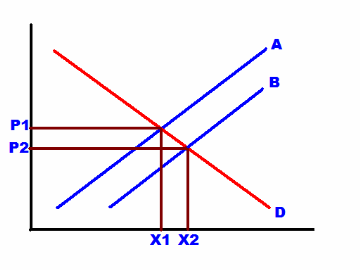
subsidy The supply schedule “A” drops to “B”, and a new equilibrium price is established at P2 where a volume of X2 is supplied. In the case of sugar, a production subsidy effectively means greater production, a lower market price, and greater consumption relative to the original market equilibrium. As costs of production are lower, more firms are able to enter the market, and marginal firms (those who would otherwise have gone bust because they are inefficient) are able to survive.

So while we have greater production, it is at the cost of misallocation of resources because of the embedded inefficiency of production that is covered by the subsidy. This can actually be calculated by the area of the triangle between the intersections of the price and volume lines, and the demand curve. That area represents a net loss to social welfare, as the money could have been used for more productive uses, or to reduce government spending and thus the tax burden. To put it in more understandable layman terms, the amount of subsidy required per unit of output will almost always exceed the drop in price achieved.

There are also negative externalities involved which are not covered by the market price or production costs, as excess consumption of sugar leads to health costs through a higher incidence of diabetes and obesity.

What happens when price controls are added to the mix? You get a really, really bad distortion of market price, demand and production:

price controls

Let’s say the government puts the price ceiling at P3, which is lower than either the original market price P1, or the subsidy induced price of P2. The retail market price will always converge to P3 – given the demand and supply curves as drawn, the price can never drop below P3, as it is uneconomical for producers to increase supply large enough for the market price to fall lower than that. So at P3, demand zooms to P4 as more and more people can afford to buy sugar, with the concomitant increase in the cost of negative externalities to society in the shape of increasing health costs.

But also at P3, the aforementioned marginal producers are out of the business as even with the subsidy previously given, their cost of production is so much higher. Other producers who could have survived even at the original equilibrium market price are also out of the business, again because their costs now exceeds potential revenues. So we have a contraction in supply to X3 – which means that there will be a permanent excess of demand and a permanent shortfall in supply. The bigger the difference between the equilibrium price (subsidy-supported or original), the bigger the shortfall will be. And the controlled price of sugar in Malaysia is a full third lower than the market price currently prevailing in our neighbours.

The only way for the government to ensure that demand meets supply at price control level P3 is to provide a subsidy that drops the supply curve to the point where the demand schedule meets P3. This is not the equivalent of a price subsidy equal to the difference between P1 and P3, which is what most people think is sufficient, but rather the difference between P4 and P3 which is an order of magnitude higher. Assuming a 45 degree angle for the supply curve, that’s equivalent to double the subsidy level from P1 and P3.

If you add intertemporal lags to changing production output (i.e. assuming a short-term inelastic supply curve), then the level of subsidy would be that much greater, as the slope of the supply curve would be steeper. A subsidy that is less than that provides an incentive for producers to hawk their produce outside the country, as they can gain more revenue for a given supply.

So what you get with production subsidies is an expansion in both supply and consumption, but at the cost of inefficient use of resources and lower productivity. What you get with price controls is much worse, with the spectre of permanently decreasing production and a constant shortfall relative to demand. And as time goes on, the situation deteriorates, as consumers feel “entitled” and as more and more producers quit the industry.

That’s the narrative that’s playing out here in Malaysia today, not just in sugar, but in rice, vegetables, and all the other items that the government cares to cap prices on in the name of consumer protection.

Thursday, May 27, 2010

Subsidy Rationalisation Lab Open Day

I attended the Open Day this morning on invitation from PEMANDU (or rather my company got invited and I was one of the truckload that got picked to go).

You can find Dato’ Sri Idris Jala’s presentation on the PEMANDU website (warning: pdf link).

Now we know where this RM74 billion figure being bandied about comes from. It includes not just officially designated subsidies, but also Petronas’ spending on the gas subsidy (which isn’t carried on the government accounts), as well as spending on education, healthcare and social services, which aren’t necessarily subsidies as the term is commonly used.

The rest of my thoughts on the subject:

  1. I think for the most part the rationalisation plan is sensible – in the political sense, though not necessarily in the economic sense. Spreading the pain over 3-5 years means less citizen anger, and gives the government time to formulate and implement a better social welfare policy – I’m not sure the mitigation proposals contained in the rationalisation plan go far enough to ensure that the subsidies that remain or newly introduced will offset the impact on the poor and lower income groups.
  2. There was a lot of general support for getting rid of consumer subsidies, especially on sugar (the stats on obesity and diabetes in the open day exhibition were truly frightening) where there were a few proposals from the floor in favour of immediate abolishment rather than phased in over 3-5 years. In this case, I think we have to take the next logical step – if sugar consumption has negative social welfare impact, then removing subsidies only partly compensates for the social costs (treatment of diabetics, healthcare for the obese and overweight). That means there’s actually a strong argument for taxing sugar as well as removing the subsidy on it.
  3. And if you buy that argument, then it goes ten-fold for petrol and other use of carbon fuels, because the environmental and social impact is so much greater. If you consume too much sugar, the costs are largely borne yourself, and partly on society through higher healthcare costs. Pollution from carbon fuel burning affects the air we all breathe, not just ourselves. That health costs are less visible, but no less powerful – check the incidence of asthma and bronchitis, not to mention lost work days from illness resulting from pollution (check this post for the basis of my argument).
  4. On the time span for rationalisation, I’m in favour of a shorter rather than a longer period. BNM apparently ran some simulations and came up with a figure of 4% in 2011-12, and back to 3% from 2013-2015 if all the proposals were implemented. To me the problem with a longer period is that you risk unanchoring inflationary expectations – i.e. people will start expecting higher inflation as a matter of course, and that means continuously higher wage demands which feed into higher inflation.  There was one proposal from the floor for the period to be shortened to 24 months – I think that strikes the right balance between spreading the pain and getting it over with as fast as possible. Five years is a long time, especially in politics, and there’s no guarantee that the political will for getting rid of subsidies will last that long. Understand that I’m not arguing against cost of living adjustments to existing wage levels – but rather a self-perpetuating cycle of price increases, which would necessitate a monetary policy response. As it is, I’m already thinking that OPR might go back to 3.5% next year, and even higher in 2012, just to mitigate higher nominal demand.
  5. There was also a lot of talk on education, although I think even the panel discussion missed some basic points. Dato’ Sri Idris mentioned that Malaysia ranks 7th in the world in spending on education per capita. If that’s the case, then the declining standards in maths and science in Malaysia suggests that money isn’t being used as effectively as it should, nor does it explain why tertiary enrollment (<30%) is so low compared to high-income economies (>60%). That’s a qualitative and quantitative issue that has to be addressed.
  6. Apart from a remark by Tan Sri Azman Mokhtar and an observation by YB Tony Pua that the fall in global oil prices meant that there is effectively no subsidy on petrol, there was little to no discussion on what to do if market prices fell below government mandated prices during the rationalisation phase – shall we go to market prices directly? Or some form of adjustment mechanism? Details here would be welcome.
  7. I’m still against the idea of providing substantive support to smallholders and small-scale fishermen. They are not productive, and no amount of technology or incentives are going to make them so. Better to provide living support (just give them cash), until the pace of development overtakes them. I know that sounds callous, but our food and agricultural production will never improve if we only look to perpetuating an existing moribund market structure that cannot survive without government support, instead of rationalising land use and capital into units that can be competitive and productive. This is of course more a political issue rather than an economic one, which is why I doubt there will be much change here.
  8. The panel discussion very nearly turned into an IPP-bashing session, and here’s hoping that there will be some movement in the direction of renegotiating the contracts.
  9. YB Tony also brought up the issue of toll highways, again. Check out his blog for details.

Thursday, January 7, 2010

Perverse Incentives And The Sugar Subsidy

The Consumer Association of Penang is calling for a halt to the sugar subsidy:

"CAP president S.M. Mohamed Idris said sugar is 'nothing less than a toxic substance' and Malaysians are consuming an average of 26 teaspoons of sugar a day.

'The recent 20sen increase in each kilogram of sugar means the Government will still end up subsidising a sinful sum of RM1bil in 2010, based on a subsidy of 80sen per kilogram...The sweet indulgence has resulted in nearly 1.2 million Malaysians with diabetes and more than 98% of them are type 2 diabetes,' he said at the CAP office Wednesday.

Referring to diabetes as the 'mother of diseases,' he said it made no sense for the Government to provide the sugar subsidy."


Actually, why stop at sugar? And why stop at abolishing subsidies?

The type of perverse incentives resulting from below market-clearing price fixing that can create a social health problem (and thus increase health costs, which are also subsidised), is also present in other subsidised products. If that's the case, a duty on sugar makes more sense from a social welfare perspective - as does a tax on petrol, for much the same reasons.