Showing posts with label exchange rates. Show all posts

Tuesday, July 24, 2018

Effective Exchange Rate Indexes: June 2018 Update

This post is seriously late, as I’ve just switched laptops and my editing software is being cantankerous. However, the NEER and REER page has been updated, as has the Google Docs version.

Summary

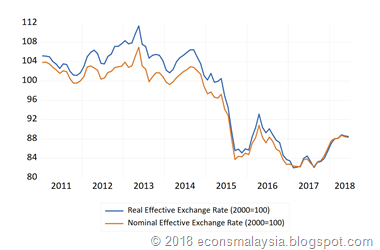
Despite the moves in the bilateral USDMYR exchange rate, there has been almost no movement in either the NEER and REER since February. This also applied to the narrow and ASEAN indexes as well. In other words, almost all the currency volatility of the past six months has been due to USD movements, with very little coming from other currencies. The nominal broad index was up 5.30% yoy, but just -0.15% on the month (REER: 4.78%, -0.15%).

Breaking down on a bilateral basis, movements were predictably mixed, with the Ringgit roughly up against half the basket and down on the other half. On a cumulative three month basis, the MYR has gained the most against the EUR (+3.15%), the GBP (+2.68%), the INR (+1.78%), the THB (+1.45%), and the AUD (+1.15%). The biggest losses were against the USD bloc countries in the basket, I.e. the USD (-2.35%), the HKD (-2.28%), and the VND (-2.18%).
01_indexes

Changelog:

  1. Indexes have been updated to June 2018
  2. CPI deflators and forecasts have been updated for May/June 2018
  3. Trade weights were updated to March 2018. This required revisions to all the indexes from Jan-18 onwards

Wednesday, June 13, 2018

Here We Go Round the Mulberry Bush

Our PM in Japan (excerpt):

Malaysia asking for yen credit to help with national debt, says Dr Mahathir

MALAYSIA is asking Japan for credit as part of efforts to resolve its debt problem, Prime Minister Dr Mahathir Mohamad said today.

Speaking at a joint press conference with Japanese Prime Minister Shinzo Abe, Dr Mahathir said he was told Japan was considering the request.

“I have explained the financial problem faced by Malaysia, and towards solving this financial problem, I have requested for yen credit from Japan and Mr Abe, the prime minister, will study this request,” Dr Mahathir said.

I don’t have much time, so I’ll keep this short. I’ll give TDM the benefit of the doubt here – he could be talking about refinancing some of the USD debt under 1MDB, which makes sense since the yield on that debt was way above market. However, using JPY loans to cover MYR debt makes no sense at all.

Thursday, April 12, 2018

Effective Exchange Rate Indexes: March 2018 Update

The NEER and REER page has been updated, as has the Google Docs version.

Summary

A late CPI release by Taiwan caused this update to be late, as well as an update to the trade weights, based on export-import data for 4Q17.

On contrast to the last few months, the Ringgit was largely stable for March 2018, though still tending to the upside.The nominal broad index was up 6.42% yoy, but just 0.05% on the month (REER: 6.23%, 0.06%). The picture for the sub-indexes was equally mixed, with the nominal broad index down –0.14% compared to February, but with the real index up 0.06%.

Still, gains were broad-based, with the Ringgit up against 11 currencies and down against just 4. The biggest gain was against the AUD (+1.52% mom), building further on gains since the middle of last year. The biggest decline was against the JPY (-1.58%), though this was after rising 5 out of the last 6 months.

01_indexes

Changelog:

  1. Indexes have been updated to March 2018
  2. CPI deflators and forecasts have been updated for Feburary/March 2018
  3. Trade weights were updated to December 2017. This required revisions to all the indexes from Jan-17 onwards

Thursday, April 5, 2018

Historical Revisionism Redux

P. Gunasegaran demonstrates – yet again – that he doesn’t understand exchange rates (excerpt):

How successive governments impoverished M'sians

A QUESTION OF BUSINESS | At least two ways - both very wrong in the longer term - were used to support the export sector in Malaysia in believing that growth through exports was the right thing for a developing country like Malaysia.

But even though there was economic growth, which means more wealth was created, there was impoverishment too. But how could that be? Basically, those who were rich got richer and those who were poor got poorer.

How did the government achieve export competitiveness over the years? Through two measures. First, they reduced the number of things Malaysians generally could buy by going for a policy which weakened the ringgit. And two, they imported poverty by allowing the uncontrolled import of cheap labour.

Friday, January 12, 2018

An Obsession With Surpluses

No, I’m not addressing the government deficit. Rather this is about Malaysia’s (slowly) diminishing current account surplus. I wrote about it at length last year (link), but here’s another flavour of the same argument (abstract):

Current Account Deficits:The Australian Debate
Rochelle Belkar, Lynne Cockerell and Christopher Kent

This paper documents the clear change of view, which has taken place in Australia over the past three decades or so, concerning the relevance of the current account deficit for policy. Historical experience under a fixed exchange rate regime suggested that large persistent deficits were unsustainable and could leave the economy vulnerable to sudden reversals in sentiment. These concerns persisted after the floating of the Australian dollar and financial deregulation, and it was thought that all arms of policy should help to rein in the then much larger current account deficits. However, these policies were shown to be ineffective and, by the early 1990s, the argument that current account deficits represent the optimal outcomes of decisions made by ‘consenting adults’ gained wide support. This paper presents some empirical evidence consistent with optimal smoothing in the face of temporary shocks; the persistence of the deficit is attributed to a modest degree of impatience relative to the rest of the world. Although it is now widely accepted that policy should not seek to influence the current account balance, the issue of external vulnerability remains of interest. Here, country-specific considerations are important, and it is argued that the factors that have made Australia relatively resilient to external shocks are also those that helped to attract foreign capital in the first place.

It's an old paper, but still relevant. I'll note in passing here two things:

  1. The underlying argument is similar to my own – whether the current account is in surplus or deficit (and the extent of that imbalance) is primarily driven by factors in the domestic economy, not the external sector or the exchange rate;
  2. Australia now has almost no FX reserves to speak of, despite being heavily exposed to trade and commodity prices, and a foreign presence in their bond market that exceeds ours. IIRC, they barely have one month cover of retained imports.

The implication is that all adjustments take place in prices instead of levels i.e. the AUD exchange rate adjusts, not their level of reserves. Despite this difference, the MYRAUD cross rate is one of the most stable I’ve ever seen outside of a pegged exchange rate. Or to put it more bluntly – despite not having accumulated “insurance” (FX reserves) against capital outflows, and thus deliberately exposing the exchange rate to greater volatility, the AUD does not appear to be any more volatile than the MYR is. There was an exception to this, running roughly from October 2008-May 2009, coinciding with the collapse of Lehman Brothers and running to the beginnings of the global recovery. But this was more the exception that proved the rule.

Notes:

Rochelle Belkar, Lynne Cockerell and Christopher Kent, "Current Account Deficits:The Australian Debate", Reserve Bank of Australia Discussion Paper 2007-02, March 2007

Wednesday, January 10, 2018

Effective Exchange Rate Indexes: December 2017 Update

The NEER and REER page has been updated, as has the Google Docs version.

Summary

December saw the Ringgit gaining for a fourth straight month across all the indexes. The NEER hit 4.1% yoy, while the REER rose 2.1%. On the month, gains accelerated, with the Ringgit gaining 1.7% in nominal terms, and 1.5% in real terms. Gains were across the board, with appreciation recorded against all 15 currencies in the indexes, the first time that has happened since April 2016.

The largest (m-o-m) gains were against the JPY (2.33%), IDR (2.30%), HKD (2.25%) and USD (2.16%). The smallest gains were against the KRW (0.71%) and GBP (0.86%).

01_indexes

Changelog:

  1. Indexes have been updated to December 2017
  2. CPI deflators and forecasts have been updated for November/December 2017
  3. Trade weights have been updated to 3Q2017. This caused revisions to the indexes from January 2017 onwards

Thursday, December 7, 2017

Effective Exchange Rate Indexes: November 2017 Update

The NEER and REER page has been updated, as has the Google Docs version.

Summary

The Ringgit has continued to strengthen across October and November. The yoy growth numbers all turned positive in November with the exception of the Real ASEAN sub-index, while mom growth has been positive for three months running. Gains were broad based, though skewed a little more against the majors, and less so against regional counterparts. The Broad Nominal Index rose 0.36% in October and 1.26% in November, while the Broad Real Index rose 0.72% in October and 1.30% in November.

In November, the only drop recorded was against the KRW (-1.35%), which has been on a tear this year. The biggest gain recorded was against the AUD (Oct: 1.89%; Nov: 3.64%).

01_eer

Changelog:

  1. Indexes have been updated to November 2017
  2. CPI deflators and forecasts have been updated for October/November 2017

Friday, October 13, 2017

Effective Exchange Rate Indexes: September 2017 Update

The NEER and REER page has been updated, as has the Google Docs version.

Summary

September was a turnaround month for the Ringgit. The year on year changes are still negative, but all six indices posted gains on the month, and the best positive performance since May-17. Capital inflows were apparently the main reason. The Broad Nominal index rose 1.26%, while the Broad Real index rose 1.04%.

On a bilateral basis, the Ringgit rose against 14 out of 15 currencies. The biggest gains were against the JPY (+2.66%), the INR (+2.49%), the KRW (+1.86%), the USD (+1.72%), and the PHP (+1.70%). The only drop recorded was against the GBP (-1.22%).

01_indexes

Changelog:

  1. Indexes have been updated to September 2017
  2. CPI deflators and forecasts have been updated for August/September 2017

Wednesday, September 20, 2017

Historical Revisionism: The MYR and SGD in the 1980s

I came across this a couple of weeks ago, but didn’t have time to address it then (excerpt):

A kleptocracy premium for the ringgit
P Gunasegaram

A QUESTION OF BUSINESS | Without a doubt the ringgit is historically rather weak even if the economy still continues to grow at a relatively healthy pace – the latest figures show a good growth of 5.8% for the second quarter of the year….

…So why does the ringgit remain weak, trading at levels which are weaker than at the height of the 1997/98 Asian financial crisis? What is it that is happening that keeps the ringgit level depressed? Perhaps it is due to a risk premium on the ringgit following the emergence of kleptocracy (re: 1MDB where as much as RM40 billion could be at risk, as thieves dip their fingers into money borrowed by a government company via bond issues) or apprehension over the ongoing spate of mega projects (re: the RM55 billion East Coast Rail Link whose cost may go to over RM100 billion….

Thursday, August 10, 2017

Ringgit Futures in Singapore

BNM is upset:

BNM Stance on Ringgit Currency Derivatives Products in Offshore Market

The recent introduction of the ringgit futures at the Singapore Stock Exchange (SGX) and the Intercontinental Exchange (ICE) or ICE Futures Singapore is inconsistent with Malaysia’s foreign exchange administration (FEA) policy and rules.

The Malaysian ringgit is a non-internationalised currency and thus, offshore trading of ringgit, in any form whether as a non-deliverable forward traded out of offshore financial centres or as a futures, options and other derivative contracts on exchanges outside of Malaysia, is against Malaysia’s policy.

Bank Negara Malaysia (BNM) would like to remind all market participants to observe the existing FEA rules. Contravention of the FEA is an offence under the Financial Services Act 2013 and Islamic Financial Services Act 2013. Appropriate action under the law will be taken against any person that does not comply with prevailing rules and regulations. Foreign participants should access the onshore ringgit foreign exchange market to meet their financial needs, either directly with onshore licensed financial institutions or their Appointed Overseas Office (AOO).

Monday, August 7, 2017

Effective Exchange Rate Indexes: July 2017 Update

The NEER and REER page has been updated, as has the Google Docs version.

Summary

After two months of gains, the Ringgit has reversed course, seeing declines across all six indexes. The REER is roughly where it was back in December, though the NEER managed to hold on to some gains, and is only slightly below November’s level. Overall, most of the indexes lost about -0.80% for July versus June, except for the narrow REER, which lost a little over -1.03%.

On a bilateral basis, losses were recorded against 12 out of the 15 currencies tracked. The biggest losses were against the AUD (-3.44%), the EUR (-2.85%) and the GBP (-1.73%), with the only gains recorded against the PHP (1.16%), the JPY (1.04%) and the TWD (a marginal 0.13%).

01_indexes

Changelog:

  1. Indexes have been updated to July 2017
  2. CPI deflators and forecasts have been updated for June/July 2017

Wednesday, July 12, 2017

Effective Exchange Rate Indexes: June 2017 Update

The NEER and REER page has been updated, as has the Google Docs version.

Summary

Over the past two months, the Ringgit has continued to gain ground, posting advances across all six indices being tracked. Most of the gains were posted in May (2.06% in the case of the real broad index), with some follow through in June (0.31%). For the latter, most of the gains were against the periphery, as the narrow index posted a small loss (-0.01% for the real narrow index). The strongest gainer was the real ASEAN index, which rose 2.34% in May and a further 0.33% in June. All told, the Ringgit has now recovered nearly all of the ground lost in the aftermath of the US presidential election.

On a bilateral basis, gains were recorded against 13 out of 15 currencies tracked in May, and 10 out of 15 in June. Across both months, the Ringgit gained against every major currency except the EUR (-1.79%), with the biggest gainer being against the JPY (+3.59%). Also, for the first time since January 2017, the REER is above the NEER, signaling a (very minor) undervaluation.

01_indices

Changelog:

  1. Indexes have been updated to June 2017
  2. CPI deflators and forecasts have been updated for May/June 2017
  3. Trade weights have been updated to 1Q2017, which entails revisions for Jan-Apr 2017

Friday, June 30, 2017

Current Account Confusion

This came out about a month ago, but the subject is important enough that it’s worth revisiting (excerpt):

The Malaysian economic indicator that is raising red flags

OF all the statistics trotted out to show the health of the economy, one indicator is causing some concern among economists, who said it spells trouble for every Malaysian over the long term.

The current account balance is a gauge for the state of the economy and if it goes into a deficit for an extended period, it affects everything from wages to the price of vegetables.

Malaysia’s current account balance still shows a surplus but the bad news is that it has been declining steadily from 2014.

Thursday, May 4, 2017

Effective Exchange Rate Indexes: April 2017 Update

The NEER and REER page has been updated, as has the Google Docs version.

Summary

For the first time since April last year, the MYR indexes have gained across the board. Having said that, the movement has been relatively small – about 0.22% on a nominal basis, and 0.27% on a inflation adjusted basis. The gains against ASEAN have been smaller, at 0.17% for both real and nominal indexes. The revised data for March however, also shows the MYR sustaining above the 100 pt index mark at 100.49, versus the preliminary reading of 99.85.

On a bilateral basis, the picture is more mixed, with gains recorded against 9 out of the 15 currencies in the broad basket. The biggest gain recorded was against the AUD (1.94%), continuing on from last month’s movement, with the KRW (0.88%) and HKD (0.84%) rounding out to the top-3. The biggest drops were against the JPY (-1.71%), GBP (-1.64%) and INR(-1.20%). The indexes continue to be crossed, with the NEER remaining above the REER.

01_indexes

Changelog:

  1. Indexes have been updated to April 2017
  2. CPI deflators and forecasts have been updated for March/April 2017. There was a technical change in the splicing procedure for Thailand’s CPI deflator, which resulted in some very minor changes to the historical series. This only affects the Real Broad and Real ASEAN indexes.

Wednesday, April 5, 2017

Effective Exchange Rate Indexes: March 2017 Update

The NEER and REER page has been updated, as has the Google Docs version.

Summary

MYR is losing out on the emerging market rally. Both indexes continued to decline, despite stability against the USD. There was a slight uptick in the Nominal Narrow Index (top 5 trading partners), but the Real Narrow Index dropped 0.26%, as inflation accelerated faster in Malaysia. The Real ASEAN index dropped the most month on month (-0.76%), but having said that, March marks the first time this particular index has dropped below 100 since June 2000.

Despite this, on a bilateral basis, MYR appears to have turned around, or at least stopped losing ground. Gains were recorded aganst 9 out of the 15 currencies in the broad basket. The nine-month losing streak against the AUD finally ended (+0.65%), with the biggest gain coming against the GBP (+1.31%). The biggest drop was against the INR (-1.65%), followed by the TWD (-0.61%) and KRW (-0.58%).

One last thing: The indexes have crossed, with the NEER now above the REER. This is largely due to inflation in Malaysia accelerating faster than our peers. Technically, if you believe this stuff, that indicates the MYR is now overvalued, though I’d reserve judgement until I get a chance to take into account nominal interest rates as well (standard UIP model).

01_indexes

Changelog:

  1. Indexes have been updated to March 2017
  2. CPI deflators and forecasts have been updated for February/March 2017

Wednesday, March 8, 2017

Effective Exchange Rate Indexes: February 2017 Update

The NEER and REER page has been updated, as has the Google Docs version.

Summary

Despite relative stability against the USD in February, the MYR continued to decline on a multilateral basis. The NEER fell -0.53% mom, while the REER fell-0.91%. More moderate drops were seen in the sub-indices.

On a bilateral basis, MYR is now on a nine-month losing streak against the AUD (-2.27%), though the biggest drop was against the KRW (-3.01%). Gains were recorded against the PHP (+0.79%), HKD (+0.37%) and USD (+0.32%). What’s interesting is that, despite the continued decline, the picture appears to be balancing out a little – gains were recorded against 6 currencies (out of a total of 14 in the indexes), versus 4 last month, and just 1 in December and November.

01_idx

Changelog:

  1. Indexes have been updated to February 2017
  2. CPI deflators and forecasts have been updated for January 2016/December 2017
  3. Trade weights have been updated for the 4Q16

Friday, February 24, 2017

Corruption, Crony Capitalism and Growth

This is slowly making the rounds (excerpt):

Where Crony Capitalism Rose and Prosperity Fell (and Vice Versa)
By Matthew A. Winkler

With populists emulating autocrats from Azerbaijan to Zimbabwe, free markets are being forced to confront crony capitalism.

One response is visible in the reversal of fortunes of Malaysia and Indonesia. The two nations still wrestle with the politics of ethnicity and religion at odds with the capitalism of market competition….

…But the historic advantage that Malaysia, with just 30 million people, has enjoyed over its Southeast Asian neighbor of 250 million is disappearing amid a barrage of corruption allegations challenging Prime Minister Najib Razak….

Tuesday, February 7, 2017

Effective Exchange Rate Indexes: January 2017 Update

The NEER and REER page has been updated, as has the Google Docs version.

Summary

Both the NEER and REER continued to decline in January, by 0.46% and 0.44% respectively, though the depreciation pace has dropped off substantially. Again, this marks new historical lows for these indices (since the beginning of the series in January 2000).

Looking at the breakdown, however, it’s really stability against the USD (and some gains against the GBP and INR), and negative against virtually everyone else. The biggest dropoff is against the AUD, where the MYR has been on an 8 month losing streak for a cumulative -11.8%.

01_indices

Changelog:

  1. Indexes have been updated to January 2017
  2. CPI deflators and forecasts have been updated for December 2016/January 2017

Tuesday, January 3, 2017

Effective Exchange Rate Indexes: December 2016 Update

The NEER and REER page has been updated. For convenience, I’ve added a Google Docs version of the data (link at the bottom of the table).

Summary

Both the NEER and REER continued to decline in December, by 1.2% and 1.5% respectively. I haven’t extended either index before 2000, as the introduction of the Euro in 1999 makes it hideously complicated to do so, but December marks the lowest levels for either index as far as the data goes back.

Just as in November, the decline was broad-based, with the biggest drops recorded against the CNY and the USD (both -0.3%). The Ringgit however continued to climb against the JPY, up 0.35% for the month.

01_indexes

Changelog:

  1. Indexes have been updated to December 2016
  2. CPI deflators and forecasts have been updated for November/December 2016
  3. Korea has rebased their CPI to 2015, which resulted in some revisions to the broad indexes

Wednesday, December 7, 2016

ICYMI: Talking FX on BFM

Me, pontificating on the Ringgit and BNM’s new measures, over the past week: